The origin of gold in the Universe explained in a simple way
Advertisements
Who has ever stopped to think about the true origin of gold in the Universe? Come and find out more about how it came about!
One of the most popular topics here at Trechos da Vida is about the origin of things.
This happens because everyone likes to know where things come from. After all, curiosity is what drives human beings!
And regardless of the topic, it's always good to acquire some general knowledge, right?
It was with this in mind that we decided to create today's material, which focuses on the origin of something we are very familiar with: gold.
Just as the vast majority of metals and minerals that are part of our planet also exist somewhere else in the Universe – and are often found in abundance on other planets.
This is the case with gold. And it is precisely about this metal – which is one of the most popular and valuable on our planet – that we are going to talk about today.
As we read the text, in addition to learning about gold and its main aspects, we will also understand together the origin of gold in the Universe!
And the best part: we’ll talk about the topic in a simple and easy-to-understand way!
Before we talk about the main topic of the text, let's understand a little more about the main properties of gold.
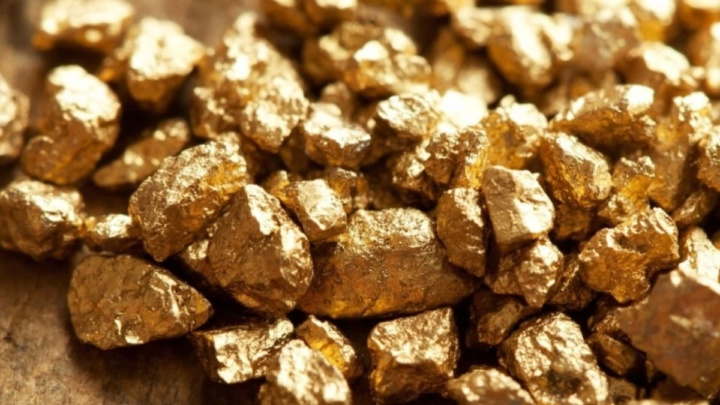
Despite being one of the most popular metals here on our planet, we thought it would be interesting to start today's content by giving a brief overview of the main information about the metal.
Gold is a metallic chemical element. And despite being a type of metal that can be found in rocks – in small quantities – and even in rivers and streams, it is considered one of the noble metals known to humans.
This type of classification occurs precisely because of one of its characteristics – almost unique – when compared to other metals in our periodic table.
Gold is known to be one of the only metals that undergoes little or no corrosion.
The origin of the word gold comes from the Latin – “Aurum” – and, in the original language, it means “brilliant”. And it is precisely the Latin name that inspired its symbol in the periodic table, which is Au.
And speaking of the periodic table, the atomic number of gold is 79 and its atomic mass is 197.
The origin of gold
Taking into account what we know about gold, it is more than common that our first answer to the question “where does gold come from?” is planet Earth, right?
That's where you're wrong!
Contrary to what many people may think, gold is far from being a treasure – pardon the pun – on our planet.
In fact, according to estimates, the origin of gold is even older than our own planet.
These estimates indicate that gold appeared more than 5 billion years ago, well before our planet began to form.
According to these studies, this and other metals considered valuable began to appear in the Universe with the occurrence of large and violent collisions of neutron stars – which are also called supernovae.
This collision would provide all the energy for this metal to emerge.
Although this theory is the most accepted, there are still scientists who point out some points that could easily discredit this theory.
And that's what we're going to talk about in the next topic.
The mystery surrounding the origin of gold in the Universe
As much as it may seem like a question that has already had its answer, the mystery surrounding the origin of gold in the Universe does not seem to have reached its final answer.
And you'll find out why.
Despite being a completely plausible explanation, some studies have shown that the means of formation that explains the origin of gold in the Universe – through collisions of neutron stars – would not be enough to explain the immense – not to say 'almost infinite' – quantity of the noble metal that exists in the Universe.
According to the researchers involved in this theory, the production of gold and other heavy metals known to us are produced through processes that, to happen, require a lot of energy from the Universe.
And some calculations carried out taking this scenario into account indicated that these processes in question – which are the only ones known and explained by human beings – would not be sufficient to produce the amount of gold that exists in the entire Universe.
In other words: if these theories are correct, there is a new way – or perhaps more than one – to explain the origin of gold in our Universe, but it has not yet been discovered by humans.
This way, it would be possible to explain why gold has been so present in our universe for billions of years.
But if the origin of Gold in the Universe is not here, why is there so much gold on our planet?
This is one of those questions that has puzzled many scientists throughout history.
The most widely accepted explanation among the research community is that many of the meteorites containing large amounts of gold ended up falling to Earth throughout the extensive formation process that the Earth went through.
This is because, due to the speed at which these meteors enter our atmosphere, they end up breaking apart, dividing into several parts.
This theory would explain the fact that gold is found in different parts of the world.
Conclusion
So, did you enjoy learning a little more about the origin of gold in the Universe and on our planet?
As you can see throughout the text, this theory may not be the only explanation for the origin of this very valuable metal in our Universe.
But still, it is very interesting to discover more facts about one of the most noble and expensive metals on our planet.
Now all we can do is wait for new studies to discover whether there really is a new way to explain the abundance of gold in the Universe as a whole.
Did you like this content? Then take the opportunity to read it too The rarest astronomical phenomena on the planet