
The Impact of Zero-Trust Technology on Personal Data Security
Advertisements
THE impact of Zero-Trust technology Protecting personal data goes far beyond a passing trend in cybersecurity.
It represents a shift in mindset: stopping the assumption that someone or something within the network is trustworthy simply because it's there.
In a scenario where data breaches expose millions of CPF numbers (Brazilian taxpayer IDs), addresses, and medical records almost weekly, this questioning approach is a game-changer—and it's no exaggeration to say it could be the difference between a hefty fine from the ANPD (Brazilian National Data Protection Authority) and an operation that continues to operate.
Keep reading!
Summary of Topics Covered
- What is Zero-Trust Really?
- How the Impact of Zero-Trust Technology How does this manifest itself in the protection of personal data?
- What real advantages does it bring to individual and corporate privacy?
- Why Ignoring Zero-Trust in 2026 Is Becoming Dangerous?
- Examples that show the Impact of Zero-Trust Technology in practice
- Frequently Asked Questions
What is Zero-Trust Really?
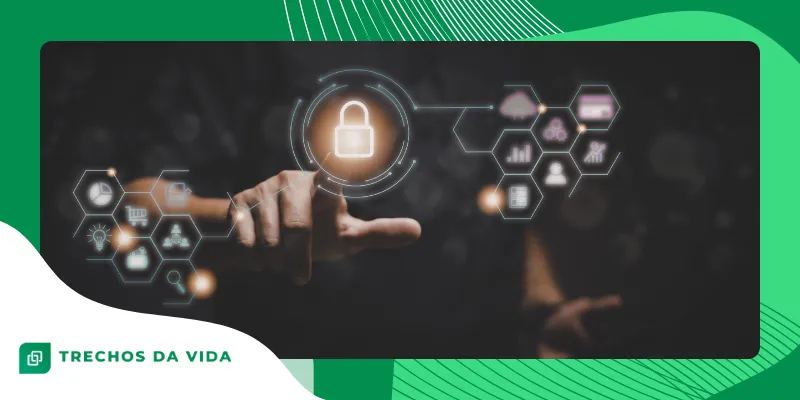
Zero-Trust isn't a product you buy and install. It's a philosophy that says: never trust, always verify — regardless of where the order comes from.
Internal networks, VPNs, remote employees: everything goes through the same rigorous screening process of continuous authentication, least privilege possible, and constant monitoring.
The term gained traction in the 2010s with John Kindervag at Forrester, but it only really took off after the pandemic, when working from home dissolved the traditional perimeter.
In Brazil, the LGPD (Brazilian General Data Protection Law) of 2020 provided an extra push: articles such as article 46 require technical measures to protect data against unauthorized access, and Zero-Trust fits perfectly into this.
There's something unsettling about all of this.
Many companies still treat security like a high wall around a castle, but the castle has had its back doors open for years — third-party applications, APIs, IoT devices.
Zero-Trust doesn't fix the wall; it simply stops trusting the wall.
Read also: Autonomous Wellbeing: How to Create a Personal Health Plan Using Technology and Self-Knowledge
How the Impact of Zero-Trust Technology How does this manifest itself in the protection of personal data?
The system is simple in theory, brutal in execution: each access is evaluated in real time based on identity, context (device, location, time), behavior, and risk.
If something smells fishy — logging in from a brand new cell phone at 3 a.m., for example — the system blocks it or asks for extra proof.
This cuts off lateral movement at the root, that phase in which the attacker, after entering through phishing, roams the network stealing everything in sight.
In environments with personal data (clinics, banks, e-commerce), micro-granular segmentation isolates leaks: if one department goes down, the patient records or purchase history of another will not be affected.
THE impact of Zero-Trust technology It also appears in terms of visibility.
Granular logs and AI-powered behavioral analysis detect anomalies early, before they become reportable incidents to the ANPD (Brazilian National Data Protection Authority).
In a country where the average cost of a data breach is still alarming—and continues to rise in regulated sectors—this rapid detection translates into real cost savings.
++ Corporate Virtual Assistants: How Brazilian Companies Are Creating Their Own Internal AIs
What real advantages does it bring to individual and corporate privacy?
For the individual, Zero-Trust means that their bank or health plan doesn't hand over their data just because the login came from a known IP address.
Adaptive authentication (biometrics + context) reduces fraud without turning every login into an interrogation.
For companies, the benefit is twofold: easier compliance with the LGPD (Brazilian General Data Protection Law) and reduced damages.
Recent reports indicate that organizations with mature Zero-Trust experience up to 45% less lateral movement in breaches, limiting the scope of leaks.
This isn't just statistics — it means fewer people needing to be notified, fewer fines, and less reputational damage.
Wouldn't it be reassuring to know that, even if someone gets into the network, your personal data remains locked in compartments that the intruder cannot easily open?
Think of Zero-Trust as a doorman who not only checks your ID at the entrance, but follows you throughout the entire building, questioning every door you try to open.
Unlike the old security guard who would let everyone through after they showed their badge.
Why Ignoring Zero-Trust in 2026 Is Becoming Dangerous?
The year 2026 no longer forgives the "trust the perimeter" model. Identity-based attacks have exploded — 84% of recent breaches involve compromised credentials.
With AI speeding up phishing and ransomware, the old castle-wall can't hold any longer.
In Brazil, the ANPD (National Data Protection Authority) has already imposed fines in the millions for data protection failures. Companies that still rely on legacy VPNs or broad access are at risk.
Adopting Zero-Trust now is not an extra cost; it's an investment that cuts future expenses — reports show reductions of up to 30% in the average cost of breaches in mature organizations.
Direct argument: continuing with implicit confidence is betting against the statistics.
Who ignores the impact of Zero-Trust technology It's basically leaving the back door open while the whole world knows where the key is.
Examples that show the Impact of Zero-Trust Technology in practice
A diagnostic clinic in Campinas implemented Zero-Trust via the cloud in 2024.
Previously, doctors accessed medical records from home without contextual verification — a stolen laptop could expose thousands of exams.
After the change, each session requires MFA + risk analysis; if access is from outside normal hours, facial biometrics are requested. In two years, zero reportable incidents, and patients are more at ease.
Another case: a small e-commerce business in Sorocaba that sold electronics.
After a card breach in 2025 (via a third-party vendor), they migrated to ZTNA. Now, the system verifies the customer's identity, device, and behavior with each purchase.
Fraud has dropped dramatically, and the owner reports that the implementation cost paid for itself in six months solely through avoided chargebacks.
THE impact of Zero-Trust technology It also appears in digital banks: continuous authentications during Pix transactions prevent a stolen token from becoming a major financial loss.
For telemedicine, consultations remain secure even on unstable home networks.
In residential IoT, smart assistants verify commands before acting, preventing a malicious application from accessing cameras.
Universities are protecting student grades and data against ransomware. Governments are using them on public service portals, increasing trust without sacrificing usability.
Impact of Zero-Trust Technology: Frequently Asked Questions
Questions that arise when people start thinking about impact of Zero-Trust technology:
| Question | Direct Answer |
|---|---|
| Does Zero-Trust slow everything down? | There may be some friction at first, but AI and optimizations reduce delays to almost zero. Users notice more security than slowness. |
| Is it expensive for SMEs? | Cloud solutions start at affordable prices (R$ 50–200/month per user). ROI comes quickly with avoided breaches. |
| Does it still work with older systems? | Yes — hybrid integrations adapt legacy systems without a complete replacement. Many companies start with critical parts. |
| Does Zero-Trust invade my privacy? | On the contrary: it limits unnecessary access and increases transparency about who sees what. |
| Is it very different from a good VPN? | VPNs trust after the connection is established; Zero-Trust never stops questioning. That's the granularity that VPNs lack. |
Want to dive deeper? Check out the official guide to... NIST on Zero Trust, Follow analyses of Forrester and see practical applications in ANPD portal.
