The scientific mystery surrounding hidden oceans on distant moons.
Advertisements
Hidden oceans on distant moons They have ceased to be mere speculation by astronomers and have become one of the most tangible enigmas of the Solar System.
They really exist: layers of liquid saltwater, trapped beneath thick crusts of ice, heated by tidal forces that stretch and compress these moons as if they were balls of cosmic mass.
What's intriguing isn't just the water—it's what it might be doing down there, far from any ray of sunlight.
Science no longer seeks to prove whether these oceans exist.
Now try to decipher if they hold records that, at some point, could have ignited the spark of life.
Keep reading!
Summary
- What exactly are the hidden oceans?
- Why do these oceans so trouble the search for life?
- Which moons guard oceans Proven or probable?
- How do we know they're there if we've never touched them?
- Two discoveries that changed the course of the conversation.
- Frequently asked questions
What exactly are the hidden oceans on distant moons?

You hidden oceans on distant moons They are global reservoirs of liquid water trapped between an icy crust and a rocky or metallic core.
Unlike our oceans, they have never seen the light of day. They depend on heat generated by the gravity of giant planets that constantly deform them.
In this sense, this gravitational dance generates internal friction, enough to keep the water flowing even at temperatures that, on the surface, would turn everything into solid ice.
The water dissolves minerals from the rocks at the bottom, circulates, and reacts chemically.
In some cases, some of it escapes through cracks and forms plumes that shoot out into space.
What makes these environments so unique is the radical isolation. No photosynthesis, no atmospheric oxygen.
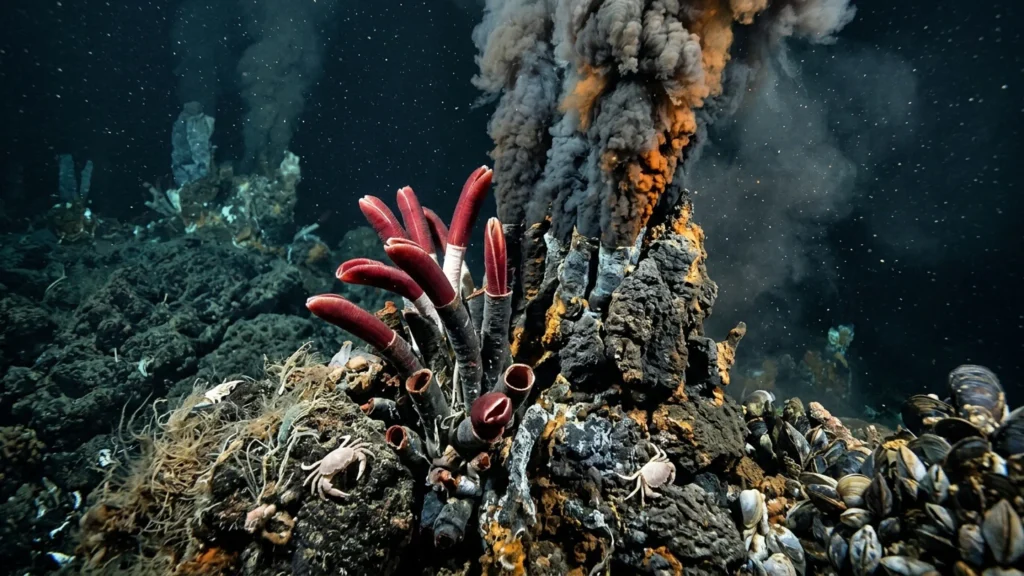
Any life there would have to survive on chemical energy coming from the depths, as happens in hydrothermal vents here on Earth.
It's a scenario that forces us to rethink what "habitable" means.
Read also: Interesting facts about clouds and little-known atmospheric phenomena.
Why do these oceans so trouble the search for life?
There's something unsettling about the idea that life can emerge in places where the surface seems lifeless.
Therefore, the more we study these hidden oceans on distant moons, But we realize that Earth may not be the only model.
Liquid water, energy, and organic chemistry seem to form a stubborn combination.
In this sense, it disrupts the old narrative that planets need to be in the Sun's "habitable zone.".
Here, habitability comes from within, fueled by gravitational tides that last billions of years.
If life has found a way to exist in these dark and pressurized environments, then the universe may be far more generous than we imagined.
Are we looking in the wrong place when we search for biosignals?
The question remains unanswered every time new data comes to light.
And the answer, for now, still depends on missions that have barely begun to deliver results.
++ How science is deciphering ancient languages with AI.
Which moons guard hidden oceans on distant moons Proven or probable?
Jupiter's Europa remains the strongest case.
Its salty ocean may contain more than twice the volume of all of Earth's oceans combined—an amount of water that impresses even those who deal with astronomical numbers all day long.
Enceladus, Saturn's small moon, has a global ocean that communicates directly with space through plumes at its south pole.
Ganymede, the largest moon in the Solar System, also harbors an ocean, possibly divided into layers by different types of ice.
Other candidates, such as Callisto or certain moons of Uranus, appear in theoretical models, but the evidence is still weaker.
What unites these worlds is the presence of enough tidal heat to prevent the water from freezing completely.
They are not copies of each other. Each one has its own recipe for depth, salinity, and internal activity.
++ Interesting things that change as you get older.
How do we know they're there if we've never touched them?
The proof comes from indirect tricks that human ingenuity has refined over decades.
The Galileo probe detected variations in Europa's magnetic field that can only be explained by a global layer of conductive saltwater.
In this way, Cassini flew through Enceladus' plumes and collected ice particles laden with salts and organic matter.
Recent analyses of older Cassini data from 2025 have revealed complex organic compounds in fresh ice grains — material that emerged from the ocean minutes before being captured.
Tidal models complete the picture: gravitational deformation generates the heat necessary to keep everything liquid.
It's not a direct photograph. It's like hearing the echo of something we don't see, but whose presence becomes undeniable when several lines of evidence align.
Two discoveries that changed the course of the conversation.
In 2005, Cassini spotted giant plumes emerging from the south pole of Enceladus.
In this sense, what appeared to be innocent vapor revealed itself, years later, to be salts, silica, and organic molecules.
A reanalysis published in 2025 showed that some of these compounds were "fresh," only minutes old, coming directly from the ocean without undergoing prolonged alteration by radiation.
It was like opening a crack to the subsoil without having to drill anything.
Europe tells a different story. Galileo's measurements in the 1990s already suggested a global ocean.
Current models estimate that, in some places, the water layer could reach a depth of 100 km.
Recently, studies from 2026 have begun to question whether Europa's ocean floor is geologically too quiet to sustain the intense chemical reactions that fuel life on Earth.
The Europa Clipper, which will collect its first data in 2026, will help to clarify this in the coming years.
Think of these oceans as locked vaults at the bottom of a frozen lake in Antarctica.
You can't see the inside, but you can measure the surface temperature, analyze the water leaking through the cracks, and hear the creaking sounds coming from below.
The analogy perfectly captures the mix of frustration and excitement that drives scientists: we know something is happening down there.
In short, all that's missing is the right way to get close.
Frequently asked questions about hidden oceans on distant moons
| Question | Direct answer |
|---|---|
| Could there be life in these oceans? | We still don't know. There's liquid water, tidal energy, and organic molecules, but direct proof is lacking. Future missions will hunt for biomarkers. |
| Why don't we just break through the ice? | The crust is tens of kilometers thick in many places. Extreme radiation, brutal cold, and distance make the operation a technical nightmare that remains unsolved. |
| Will the Europa Clipper solve the mystery? | Not entirely. It will map the crust, measure the ocean indirectly, and identify promising locations. It arrives at Jupiter in 2030 and begins detailed flybys afterward. |
| Is Enceladus easier to study than Europa? | Yes, because the plumes bring samples from the ocean to us. That's why Cassini achieved so much with a single flyby. |
| What if we only find simple microbes? | Even so, it would be revolutionary. It would show that life can arise in environments without sunlight, greatly expanding the possibilities in the rest of the universe. |
What remains after thinking about these oceans?
You hidden oceans on distant moons They force us to broaden the definition of "home".
You don't need blue skies, beaches, or green plants.
In this sense, all that is needed is liquid water, rocks to react with, and a persistent source of energy.
While Europa Clipper continues its journey and Cassini's data continues to yield surprises, science advances with patience.
In short, we're not hunting alien sea monsters. We're trying to understand if the chemistry of life is more common than we dream.
For those who want to delve deeper:
- Evidence for an Ocean on Europa – NASA
- Cassini Study Finds Organics 'Fresh' From Ocean of Enceladus – NASA
- Ocean Worlds – NASA
The mystery hasn't been solved. It's just become clearer. And, in a way, that makes it even more irresistible.