Parker probe touches the Sun for the first time
Advertisements
The sky is far from the limit for science. And one of the latest technological achievements through the Parker Probe is clear proof of that!
One of the main objectives of space scientists is to unravel the mysteries and better understand the activities of the most important star in our solar system: the Sun.
For years, several types of studies have been carried out to try to better map solar activities and understand the effects that these changes can have on our lives and on the dynamics of other planets that are part of our solar system.
That is why the latest news related to studies of the Sun is causing such a stir around the world.
Recently, one of NASA's space research probes achieved a feat never seen before: "touching" the Sun for the first time.
But you must be wondering: “How could a space probe enter the Sun’s orbit without being completely burned up?” Come and we’ll explain everything about it!
In today's content, you will learn about this new development and better understand the procedures that were part of the project and the consequences that this achievement will have for science.
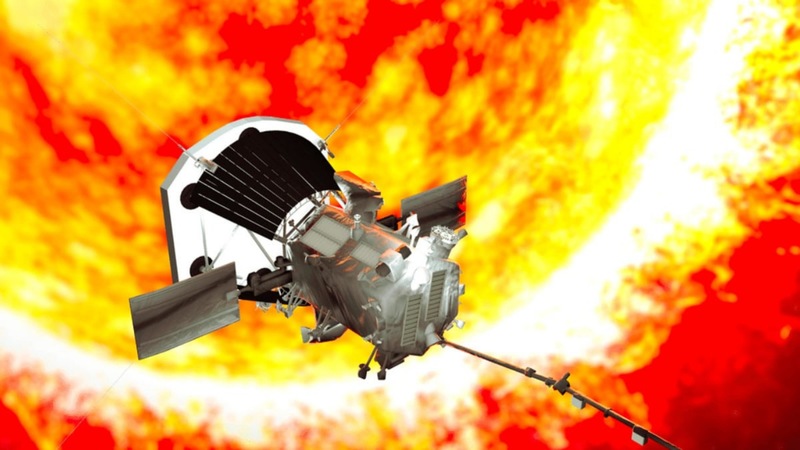
What is the Parker probe?
How about we start from the beginning?
The Parker Solar Probe – or Parker probe – is a space probe from NASA, the United States government agency responsible for the study, research and development of technologies and programs aimed at exploring space.
Named after astrophysicist Eugene Parker – a leading author in the study of solar winds – it is estimated that the Parker probe project cost more than 1.5 billion dollars.
With a duration of almost 7 years, the excursion towards the Sun is expected to return to our planet only in 2025.
The trajectory of the Parker probe
Although the Parker Probe's achievement is very recent, its journey to this point is relatively long.
Launched in 2018, its main objective is carry out studies and help scientists better understand the activities related to the largest star in our solar system, orbiting the star.
To fulfill its mission, the probe has been gradually approaching the star.
Only in April 2021, during one of these approaches, the probe carried out a new flyby and identified specific conditions of solar activity.
It was after this update that scientists were able to confirm that the Parker probe was present in the solar corona – also known as the upper atmosphere – of the Sun.
Through the approach, the probe seeks to obtain samples of particles and the star's magnetic fields.
Another point that draws attention to the Parker probe is the speed at which it travels.
On this mission to “touch” the Sun, it is estimated that the probe is traveling at more than 500,000 km/h. This speed has earned it the title of the fastest spacecraft ever created by humanity.
Why is this achievement so important?
The feat accomplished by the Parker probe caused a huge commotion within the scientific community.
This is due to the fact that, since research into space began, this is the first time that a space probe created by humans has been able to make such important recordings close to the Sun.
In general, such activities and structures of the star can only be seen during solar eclipses.
This made the images captured by the Parker probe during the mission so important and so widely circulated among scientists, astrophysicists and scholars of the subject all over the world.
With these records, NASA scientists have more material to carry out deeper research and studies regarding the evolutionary process of the Sun, understand a little more about the future of the star and better understand the impacts that such processes can cause in our solar system.
Furthermore, by carrying out studies like these, in addition to understanding more about the dynamics of the Sun, it is also possible to understand a little more about the other stars present in our universe, but which have not yet been discovered or properly explored.
How was the Probe not damaged during this mission?
And the question that everyone wants to know is: how did a space probe like the Parker Probe manage to touch the Sun and document such an act without suffering damage caused by the high temperatures?
This has a very simple explanation.
Despite all the technical preparation to orbit the Sun safely, in this case, the use of the term “touched” is more illustrative, to make it easier for people to understand the situation.
In fact, the mission of which the probe is part did not actually touch the Sun – because that would be impossible.
What happened was that, during the flyby that resulted in the recording released by NASA, the Parker probe passed about ~only~ 13 million kilometers from the photosphere, the visible layer of the Sun.
Recently, after the release of the flyover records, NASA itself issued a statement about the mission, comparing the area visited to the center of a hurricane.
According to NASA, the recorded location presented calmer conditions compared to other points explored by the probe.
Hence the comparison with the eye of a hurricane which, despite being located in the center of the atmospheric phenomenon present on Earth, is known to be the calmest point of a hurricane.
But as such a feat is considered unprecedented – as already mentioned throughout the text – it can be said that the Parker probe became the first space probe to touch the Sun.
The future of the Parker probe mission
After this discovery, scientists and scholars in the field are even more excited about the future of the mission and the next steps that the Parker probe will take.
The probe, which continues orbiting the Sun, is expected to perform a new flyby in January 2022. In total, during the almost 7 years of the mission – from 2018 to mid-2025 – it is estimated that the Parker probe will perform more than 20 attempts towards the Sun, always aiming to gather more information about the dynamics and functioning of the main star in our solar system.
Did you like this content? Take advantage and read it too Contactless Payment – See how this technology works