
Storms and thunderstorms: how do they form and which were the worst?
Advertisements
There are two natural phenomena that, because they are similar, can cause confusion: storms and thunderstorms. Find out more about them and understand how each of them is formed!
If you are someone who follows TV, radio or social media, you may have already noticed that some regions of the United States are facing a very complicated situation: the passage of Hurricane Ian.
This natural phenomenon is causing a lot of fear and destruction as it passes through, and in some parts of the country, it is estimated that Hurricane Ian will reach level 5 – which, for those who are not familiar with the subject, is the strongest type of hurricane known.
And it was with Hurricane Ian in mind that we had the idea to create the content you are about to read.
Unlike the United States – which faces hurricanes with some frequency – Brazil is a country that does not suffer from this type of situation.
But even if there are no hurricanes here, that does not mean that we are free from natural phenomena that, despite having a much lower intensity and destructive capacity than hurricanes, occur quite often.
And, in some cases, they can cause a lot of inconvenience for Brazilians. We are talking about phenomena such as storms and thunderstorms.
But how do you know how these phenomena form? And what have been the worst recorded events when it comes to storms and thunderstorms?
That's what we're going to find out together today! So get your umbrella ready because today we're going to face storms and thunderstorms together!
Storm and thunderstorm | What is each of these phenomena?
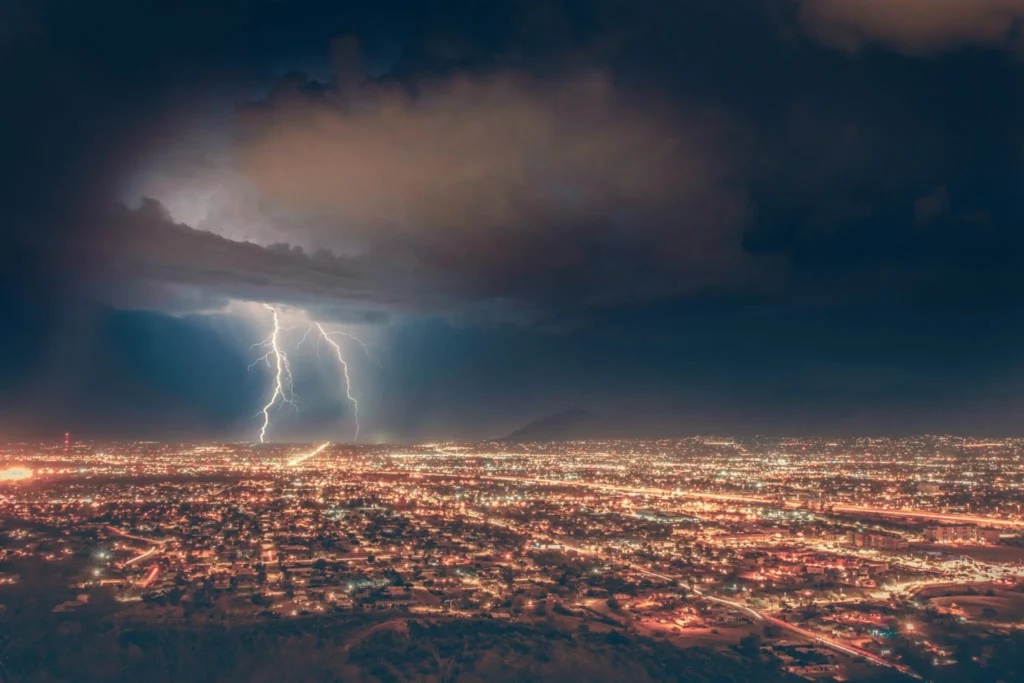
Although most people are already familiar with what storms and thunderstorms are in general, we thought it would be important to provide more context about each of these phenomena.
Storm
A storm – also popularly known as a thunderstorm – is a meteorological event.
Despite the name, storms are not always marked by their intensity. However, they are almost always associated with their severity.
Among the main characteristics of a storm are the famous strong winds, with intense gusts, thunderstorms and very heavy precipitation (usually rain, hail or, depending on the region of the world, these events can even include snow.
Thunderstorm
Thunderstorms can be just as scary as a storm. After all, I think everyone knows someone who is afraid of a storm that is accompanied by a lot of thunder, right?
Thunderstorms are directly linked to sudden discharges of atmospheric electricity. This meteorological phenomenon is defined as a succession of electrical discharges and thunder, usually accompanied by precipitation.
In addition to the famous thunder, another common characteristic of this type of situation is the brief and intense brightness – the famous lightning and flashes – and the thunder, which causes so much fear in many people out there.
Take the opportunity to read it too 👉 Animals that are immortal: meet 3 species! You didn't expect this one!
Storm and thunderstorm | How each of them forms
For those who are not so familiar with the field of meteorology – responsible for the study of events that are part of the weather – we will give a brief explanation of how storms form.
Thunderstorms are formed when clouds higher in the sky are charged with a positive charge and -/ lower ones are charged with negative charges.
This sequence of events ends up inducing the creation of an electric field.
Lightning – almost obligatory when we are talking about storms – appears when electrons present in the clouds are passing from one cloud to another – or from one of the clouds to the Earth.
But what about the noise caused by these situations? What is the origin of the dreaded thunder?
It is precisely at the moment when, instead of passing from one cloud to another, the electric spark that we know as lightning 'decides' to come to Earth.
This movement is what causes the loud sound. And this happens because of the expansion of the heating of the cold air by the electrical discharge.
What were the worst storms?
Did you know that being named is not exclusive to hurricanes and tornadoes?
In some parts of the world, very strong storms are also given names. Around the world, there have been storms that have been given names like Ana, Bruno, Carmen, David, Emma, Felix, and so on.
And depending on the intensity of a storm, it can cause serious damage that can be comparable to more dangerous meteorological phenomena, such as tornadoes.
Below, we have separated some of the worst storms known in recent times.
Starting with Bangladesh, which is one of the most populated countries in the world, it is a country that suffers greatly from the effects of intense storms.
So much so that the country appears in first and second position in this topic.
The first time occurred in 1970 and, according to records, the storm resulted in around 300 thousand deaths.
The second storm that appeared here and occurred in Bangladesh was more than 20 years after this first occasion, in 1991.
In this second storm, the death toll may have been lower, but it was still impressive.
In this second storm, the death toll exceeded 138,000.
The second country is China. The second – or third, if we take into account the two from the previous topic – happened in China, exactly 100 years ago.
On this occasion, the death toll was 100,000. It is clear that this is just an estimate, since at that time it was much more difficult to measure the damage caused by these events.
Rounding out this top 3, we have India.
Despite having a much lower death toll than the first two positions, the number is still impressive.
The storm in question occurred in 1935 and resulted in around 60,000 deaths.
Storm and Thunderstorm | What are the worst storms ever recorded?
Conclusion
So, what did you think of this brief lesson on what a storm and thunderstorm are?
Now that you know what each of them is and how they are formed, it's easier to identify each of them, right?
And now you are more than prepared to witness the next period of rain and storms with more knowledge.
Did you like the content we prepared for you? Then I think you will also enjoy reading The most famous and disastrous tsunamis in history
