How does the underconsumption movement influence the daily economy?
Advertisements
Underconsumption core It is changing, quietly but steadily, the way many of us handle money on a daily basis.
Instead of chasing after every new thing that pops up on your feed, the movement invites you to look more closely at what you already have at home — that scratched pan that still cooks perfectly, the coat that survived two winters and is still warm.
It's not about living with almost nothing. It's about stopping treating consumption as the primary form of entertainment.
Here we delve into how this trend affects the economy we truly feel: the economy of groceries, wardrobes, and the bill at the end of the month.
Continue reading the text!
What is the underconsumption core?
THE underconsumption core It goes against the logic that pushes us to buy something new every week just because it appeared in a video.
He celebrates the honest use of things: extending the lifespan of an object, repairing instead of replacing, choosing carefully.
There's something unsettling about this trend. Many people still confuse the term with an aesthetic version of disguised poverty.
In fact, it is a conscious refusal of the constant urge to "update".
Shoes with worn soles, notebooks almost empty, electronics that still work well — all of these things regain value.
Ultimately, the movement reflects a collective perception that has grown in recent years: accumulating things does not fill the void that advertising promises.
Especially when inflation eats away at part of your salary every month, this approach transforms financial pressure into a more intentional choice.
Read also: Sensory wellness practices that help regulate emotions.
How the underconsumption Did it emerge and gain strength?
THE underconsumption core It exploded on TikTok in mid-2024 as a direct counterpoint to the famous "haul" videos full of shopping bags and unboxing.
Creators began to showcase the opposite: what they didn't buy, products they're using up down to the last gram, and DIY projects that gave new life to old items.
The timing was not random.
After years of rising living costs, especially following the pandemic, many people have grown tired of seeing influencers turning shopping into mandatory content.
In Brazil, where budgets are tight in different ways in each region, the movement quickly found an echo.
It didn't emerge from nowhere. It's a product of "de-influencing" and carries echoes of older discussions about conscious consumption.
Today, in 2026, it has moved somewhat beyond the niche of social media and is appearing in real conversations about family budgeting and practical sustainability.
++ The impact of Pix installment payments on credit cards in commerce.
How the underconsumption core Does it influence the daily economy?
When someone decides not to buy that piece of clothing just because "it's in fashion," that money simply stays in their pocket.
Multiplied by thousands of people, the effect is seen in fast fashion sales and in promotions that lose momentum.
But the movement doesn't paralyze the economy — it redirects it. Resources migrate to thrift stores, repair shops, more durable products, and even local repair services.
A family that adopts this mindset tends to reduce impulsive spending and gain some breathing room to pay off debts or save for unexpected events.
In this sense, some see this as a risk to growth. In practice, what happens is a more stable domestic economy.
Less pressure to create new things frees up mental and financial energy.
And this makes a real difference in everyday life: less stress when it comes to balancing the books, more room for choices that truly matter.
++ A guide to saving money in everyday life with apps that cut expenses.
What are the impacts? underconsumption Does it bring anything for personal consumption?
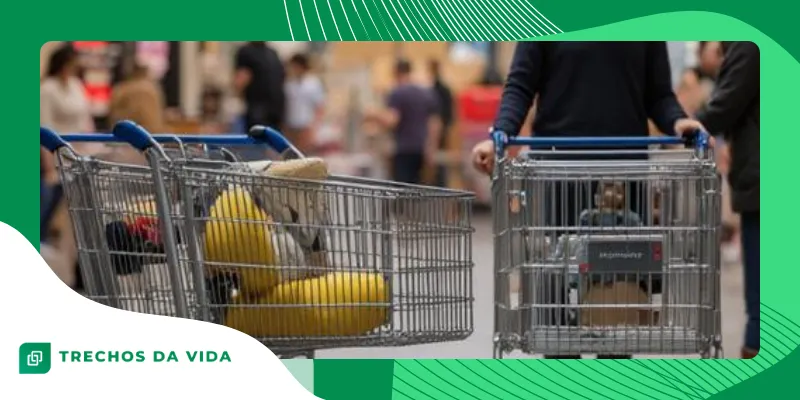
In everyday life, the underconsumption core It transforms going to the market into a moment of quick reflection.
Instead of impulsively filling the cart, the most uncomfortable question arises: "Do I really need this, or am I just used to buying things?".
Over time, the monthly budget breathes easier.
In this way, spending on disposable fashion, unnecessary gadgets, and household items that don't last long decreases.
What's left over can go towards experiments or to strengthening the emergency fund — something that many Brazilian families have learned to value after recent crises.
Furthermore, the movement encourages skills that had been somewhat forgotten: sewing on a button, repairing a simple household appliance, bargaining at thrift stores.
In Brazil, where the cost of living varies so much, these small skills can mean the difference between always living on the edge and having a little leeway.
Practical and original examples of underconsumption core in real life
A 34-year-old accountant here in Sorocaba has been using the same work laptop for over five years. She replaced the battery, installed an SSD, and that was it.
Therefore, instead of spending money on a new model every year, he directed the money towards a course that increased his income.
For her, underconsumption core It's not giving up — it's a smart strategy.
Another case that came to mind is that of a couple of teachers who decided to eliminate food waste.
They plan meals, freeze leftovers, and transform scraps into new dishes.
In this sense, the result was a drop of approximately 25% in monthly supermarket spending.
The money saved now pays for short trips with the children.
In this way, these examples show how the movement adapts to Brazilian reality without falling into empty romanticism.
An analogy that clarifies the underconsumption
Imagine an old orchard, the kind your grandfather used to tend with patience.
Instead of cutting down old trees every season to plant "more modern" saplings, he prunes, fertilizes the soil, and harvests what is already there.
The orchard continues to produce good fruit, more resistant and with a flavor that new seedlings take years to achieve.
In this way, it's more or less like this: underconsumption core It works in the daily economy.
We keep what still serves its purpose, improve what can be improved, and avoid the cost—both financial and emotional—of constantly starting from scratch.
Comparative table: traditional consumption × underconsumption
| Aspect | Traditional Consumption | Underconsumption core |
|---|---|---|
| Main focus | New and quantity | Durability and real-world use |
| Impact on the budget | Recurring impulse spending | An economy focused on what really matters. |
| Relationship with the environment | High levels of waste and frequent disposal. | Smaller footprint, constant reuse. |
| Long-term satisfaction | Dependent on new acquisitions | Contentment with what already exists and works. |
| Effect on the local economy | It encourages mass retail and disposable products. | It strengthens local thrift stores, repair shops, and services. |
This comparison helps to show that the underconsumption core It doesn't eliminate consumption — it makes it more conscious and, often, more humane.
Frequently asked questions
| Question | Response |
|---|---|
| THE underconsumption core Does it mean never buying anything new? | No. It means buying only when necessary and prioritizing quality and real usefulness. |
| Could this harm the economy as a whole? | It may slow down some sectors of excessive consumption, but it stimulates others, such as repair and the circular economy. |
| How to get started in practice? | First, assess what you already have at home and commit to using it to the maximum extent possible. |
| THE underconsumption core Is it only for people with little money? | No. It's a choice that makes sense at any income level because it prioritizes financial freedom. |
| What is the difference between underconsumption core And minimalism? | THE underconsumption core It values "lived experience" and prolonged use; minimalism tends to focus more on clean aesthetics. |
Why is it worth reflecting on the underconsumption core today?
THE underconsumption core It promises neither miracles nor radical revolutions.
He gradually builds a more balanced relationship with what we spend and what we save.
There's something liberating about that.
In a world that demands constant updating, deciding that what already works is still useful can be a small act of resistance.
Less mental noise, more space for what really matters.
Ultimately, the movement reminds us that purchasing power doesn't need to be exercised all the time to generate value in real life.
Recommended sources for further reading: