The city submerged in Lake Guatemala for over 2000 years.
Advertisements
Can you imagine traveling and, while diving, finding an underwater city?
As you may know, our planet has changed quite a bit over the years.
Before humans became as evolved as they are now – and before they exerted the daily influence we do on our planet – these changes were almost always linked to natural activities, such as volcanoes, earthquakes, and floods.
This results in hundreds of cities and towns that, despite having been home to diverse peoples in the distant past, are now submerged.
Although in most cases these floods occurred over many years, not every situation was like that.
Whether from seawater, rivers, or even lakes, the action of water in these situations is usually relentless, leaving residents with no alternative but to flee and seek settlement in other locations.
With that in mind – and taking advantage of a recent discovery involving a city submerged for over 2,000 years – we decided to create this material!
Throughout this content, you will learn more about how this discovery, so important to history, came about and what the next steps are regarding this city!
Discover the incredible underwater city in Lake Guatemala.
Our story begins in Guatemala. Well, actually, it's a new chapter in a story that began thousands of years ago.
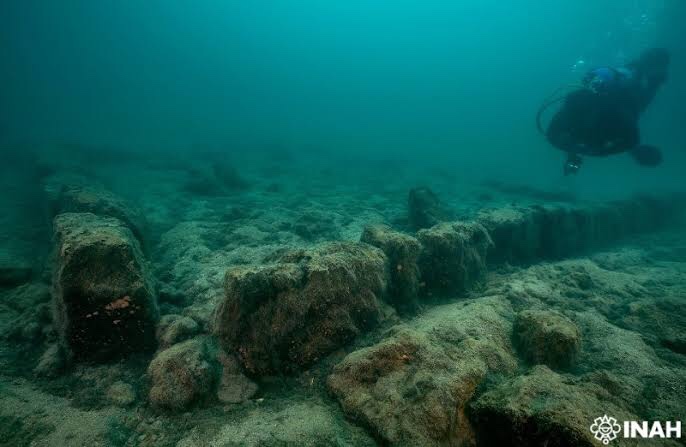
The discovery in question is a submerged city found in a lake in Guatemala.
Found at the bottom of Lake Atitlán, the discovery is a Mayan city that is over 2,000 years old.
According to those responsible for exploring this discovery, the city was located right in the middle of the lake and, contrary to what one might imagine, it had an excellent infrastructure.
It has already been established that the submerged city had houses, temples, and even squares.
But how could a city with all that infrastructure have been swallowed by the waters and ended up at the bottom of Lake Atitlán?
Theories about the submerged city
Although there is still no definitive answer as to why the Mayan city ended up at the bottom of the lake, the scholars, researchers, and scientists involved in the exploration project already have their theories.
Among them, the most prominent is that the city may have been submerged due to some kind of volcanic activity.
Remember that we mentioned in the previous topic that the city was located in the middle of a lake.
That's right. Lake Atitlán is actually a volcanic crater formed thousands and thousands of years ago.
The San Pedro volcano was responsible for the activity that gave rise to the lake.
Located at a considerable elevation – more than 1,500 meters above sea level – many scholars support the theory that San Pedro was the main reason why the Mayan city was submerged in the lake.
And this theory isn't so hard to imagine. After all, as everyone knows, a volcanic eruption usually brings consequences ranging from tremors to more serious situations.
Therefore, upon becoming active, the San Pedro could very well have affected the city so severely that it caused it to sink into the depths of Lake Atitlán.
And since we're talking about volcanoes, this website also has special content about some of the worst volcanic eruptions. To read this content, just click [here]. here.
What was found in the submerged city in Guatemala?
Needless to say, the discovery of this city was a tremendous event, right?
After all, the Maya possessed one of the richest cultures in the entire world. And this was proven once again by the findings in the city of Atitlán.
In the city – which is submerged between 12 and 20 meters deep – various items that were once part of the city were found, such as ceramics and other Mayan artifacts.
According to archaeologists, the new submerged archaeological site preserves some historical items that, according to estimates, date from around 400 BC to 250 BC.
One impressive aspect is the preservation of some of them, despite being submerged for so many years.
The next steps involve using technology to better map the discovery without putting the structure – or anyone – at risk.
Other submerged cities that have been discovered around the world.
Despite being a groundbreaking discovery, the submerged city in Guatemala is neither the first nor the last underwater discovery made by man.
Remember how we mentioned at the beginning of the text that there are many, many other submerged cities that have been discovered throughout history?
In this section, we'll show you some of these cities so you can get to know them!
Pavlopetri, the oldest submerged city in the world.
If you thought Guatemala City was old, this one will impress you even more!
Located in Vatika Bay, Greece, Pavlopetri is a city that was home to a society that lived approximately 5,000 years ago.
Among the discoveries found in the city, archaeologists discovered streets, courtyards, more than 10 buildings, and even a cemetery.
Canopus, the submerged Egyptian city
Another very famous submerged city is located near Alexandria, in Egypt.
Even after its discovery, the site still contains various relics, such as ancient sanctuaries of Osiris and Serapis.
Some archaeologists believe the city sank after a major flood occurred on the Nile River.
Shicheng and its recent flooding
The third city on our list is a different case from the others.
Although the city – located in China – was built approximately 1,300 years ago, its flooding occurred quite recently, in the last century.
Conclusion
What did you think of this trip through the underwater cities of the world?
Learning more about these cities makes us reflect on the future of humanity.
With the advance of global warming, the trend is that many cities will also be submerged in the not-too-distant future.
And that is, at the very least, quite worrying.
Did you enjoy this content? Then take the opportunity to read also 5 underwater museums to visit in the world