Egg-laying mammals defy known evolution.
Getting to know mammals that lay eggs It forces any attentive observer to abandon the comfortable drawers where we usually lock nature away.
Advertisements
For a long time, we learned in school that reptiles lay eggs, birds have beaks, and mammals gestate their young in the uterus. But biology, when looked at closely, rarely respects our didactic boundaries.
In the rivers of Australia and the forests of New Guinea, five species of the order Monotremata continue to live outside these rules, blending heritages of over one hundred million years with sensory refinements that still intrigue geneticists.
Summary
- What are the only egg-laying mammals in existence today?
- How do monotremes challenge the traditional evolutionary tree?
- Where do platypuses and echidnas live, and how do they behave?
- How does reproduction without a uterus and breastfeeding without nipples work?
- Comparative table of the five current species of monotremes.
- Frequently Asked Questions (FAQ)
What are the only egg-laying mammals in existence today?
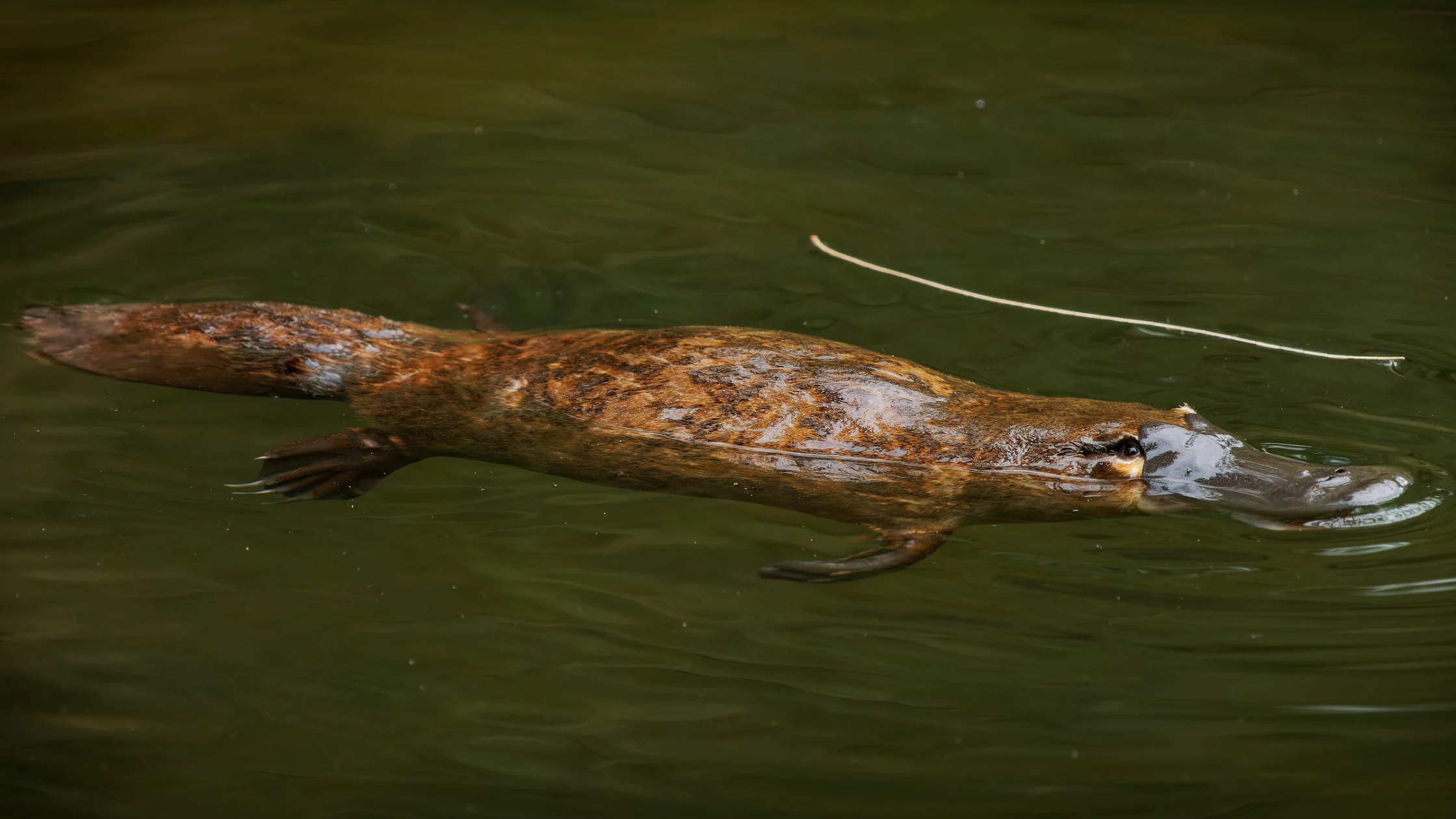
Today, this entire peculiar branch of life is reduced to five survivors: the platypus and four species of echidnas. There are no others.
When the first European naturalists received dried platypus skins in the 18th century, many swore it was a hoax stitched together by Asian taxidermists—the duck bill attached to a furry body and a beaver tail seemed like an anatomical joke. This skepticism made sense given what science knew at the time.
Still, the creature was real. And, alongside it, were the echidnas: the short-beaked echidna (Tachyglossus aculeatus) and three species of the genus Zaglossus, called long-beaked echidnas.
While the platypus belongs to the water, echidnas prefer dry land, protected by keratin spines and equipped with claws that tear through tree trunks and hard soil with impressive ease.
What unites such different creatures is not just the laying of leathery eggs, but the persistence of a biological arrangement that functions without asking permission from human categories.
Observe these mammals that lay eggs This makes it clear that evolution doesn't climb a ladder toward perfection; it merely maintains what continues to solve problems.
How do monotremes challenge the traditional evolutionary tree?
This is often misinterpreted even today: many people still call the platypus and the echidna "living fossils" or missing links, as if they had stopped in time waiting for the arrival of modern mammals.
Genomic analysis has debunked this lazy idea. Far from being unfinished sketches between ancient reptiles and placental mammals, monotremes continued to evolve on their own for millions of years, accumulating highly specialized solutions.
There is something almost unsettling when we open the genetic code of these animals. They carry a mosaic of sequences shared with birds, reptiles, and eutherian mammals—not by accident, but because they have preserved entire blocks of a common past before the great separation of these lineages.
Instead of the classic X and Y pair that defines sex in humans, monotremes operate with ten sex chromosomes, some of which are directly related to the Z system of birds.
At the same time, they abandoned their teeth in adulthood, replacing them with horny plates that crush prey without needing tooth enamel.
Even the stomach followed its own path, losing the hydrochloric acid and pepsin-producing glands that we consider standard in vertebrate digestion.
The details of this chromosomal puzzle are documented in the publications of scientific journal Nature, where international teams mapped the genetic architecture of the order Monotremata.
Ultimately, egg-laying mammals do not represent an evolutionary setback—they represent another historical gamble of life, equally shaped by time.
Where do platypuses and echidnas live, and how do they behave?
None of these animals survived outside of Oceania. Australia, Tasmania, and New Guinea functioned as a kind of geographic vault, isolated by the ocean long enough for ancient lineages to thrive without the direct pressure of large placental predators.
In the streams and lakes of eastern Australia, the platypus spends its nights diving in search of shrimp and larvae. As soon as it enters the water, it closes its eyes, ears, and nostrils—and, even blind and deaf at that moment, hunts with surgical precision.
The secret lies in the soft skin of the beak, full of electroreceptors capable of picking up the tiny electrical signals produced by the muscles of prey hidden under the mud. It's an invisible reading of the environment, closer to the radar of certain sharks than to any terrestrial sense.
And there's another detail that's often overlooked: the males have hollow spurs on their hind legs connected to venom glands. They're not used for hunting, but to compete for territory and females, causing pain so intense that common painkillers barely provide relief.
On land, echidnas follow a different rhythm. The short-beaked echidna travels from dry deserts to humid forests, breaking open termite mounds and sweeping up ants with its long, sticky tongue.
Long-beaked echidnas, on the other hand, prefer the damp, shady mountains of New Guinea, probing the soft soil at night in search of earthworms.
When danger appears, they don't run away: they curl up into a sphere of thorns or sink vertically into the earth until only an impenetrable shell remains in sight.
How does reproduction without a uterus and breastfeeding without nipples work?
The word "monotreme" itself comes from Greek and reveals an unusual body architecture: a single opening. Just as in birds and reptiles, the intestine, urinary system, and reproductive system all empty into the same cloaca.
After fertilization, there is no placenta or prolonged gestation. The female lays one or two small eggs with a soft, parchment-like shell, measuring about fifteen millimeters.
The female platypus retreats to a burrow dug in the riverbank and wraps the eggs between her tail and abdomen for about ten days.
The echidna adopts a portable solution: it deposits its single egg inside a temporary fold of skin on its belly, carrying the incubator with it.
When the hatchling breaks through the shell with a small, temporary tooth, it looks more like a pink larva than a mammal—blind, hairless, and utterly defenseless.
This is where one of the most peculiar scenes in biology takes place. The females produce milk rich in nutrients, but they don't have nipples.
The liquid runs directly through the pores of two abdominal plates and moistens the surrounding fur, from where the newborn patiently licks it all off.
This milk contains unique antimicrobial proteins, such as lactation monotreme protein, which acts as a chemical shield against bacteria in damp, enclosed burrows.
Not surprisingly, pharmaceutical laboratories have begun investigating these molecules in search of new weapons against infections resistant to traditional antibiotics.
Suddenly, an anatomical eccentricity of the mammals that lay eggs It ceases to be merely an encyclopedia curiosity and begins to engage in dialogue with 21st-century medicine.
++ Nubank Ultraviolet: Unlimited Cashback that Earns 200% of the CDI Every Day
Comparative table of the five current species of monotremes.
To see side-by-side where each species lives, what it eats, and the degree of threat it faces today, it is worth observing the overview below.
| Species | Scientific Name | Main Habitat | Predominant Diet | IUCN Status |
| Platypus | Ornithorhynchus anatinus | Rivers and lakes of Eastern Australia | Crustaceans, larvae and aquatic worms | Near Threatened |
| Short-beaked echidna | Tachyglossus aculeatus | Deserts, savannas and forests of Australia | Ants and termites | Of little concern. |
| Western long-snouted echidna | Zaglossus bruijnii | Mountainous forests of New Guinea | Earthworms and soil invertebrates | Critically Endangered |
| Eastern long-snouted echidna | Zaglossus bartoni | Tropical highland forests in New Guinea | Earthworms, larvae and subterranean insects | Vulnerable |
| Attenborough's long-snouted echidna | Zaglossus attenboroughi | Cyclops Mountains in Papua | Earthworms and small invertebrates | Critically Endangered |
Attenborough's long-snouted echidna has an almost cinematic history: it went more than sixty years without any confirmed records, considered possibly extinct, until it reappeared in front of camera traps installed in the mountains of Papua.
++ Recovering Deleted Photos, Videos, and Files on Mobile Phones
What do fossils reveal about the ancient origins of these animals?
Before becoming confined to Australian rivers and the forests of New Guinea, the ancestors of mammals that lay eggs They traveled much more extensive routes across the southern hemisphere.
Paleontological records found in Argentine Patagonia, such as the Monotrematum sudamericanum, Studies prove that close relatives of the platypus swam in South American rivers more than sixty million years ago, when the southern continents still maintained land connections through Antarctica.
These fossilized remains — identified primarily by uniquely shaped molars and mandibular fragments — show that monotremes already possessed sophisticated aquatic adaptations long before their definitive isolation from Oceania.
With continental drift and the cooling climate that froze Antarctica, only the lineages sheltered in the Australian block resisted the environmental changes, preserving to this day a biological heritage that once belonged to the entire ancient supercontinent Gondwana.
Conclusion
Perhaps the greatest merit of the platypus and echidnas is not that they seem strange to us, but that they expose how our biological classifications are merely provisional maps of a much more inventive territory.
By grouping together egg-laying, underwater electroreception, defensive venom, nipple-less milk, and hybrid chromosomes in the same category, nature forces us to exchange easy certainties for genuine curiosity.
Losing any one of these five species would mean erasing unrepeatable chapters of evolutionary history that also shaped placental mammals.
Anyone wishing to follow the updated surveys on extinction risk and conservation efforts can consult directly the Red List of the International Union for Conservation of Nature.
Frequently Asked Questions (FAQ)
Why are the platypus and the echidna still considered mammals if they lay eggs?
Because they possess the central traits of the class Mammalia: they have mammary glands that feed their young with milk, they have fur, they maintain their internal body temperature, and they have three ossicles in their middle ear.
Can platypus venom kill a human being?
While not lethal to healthy adults, the sting from the male's spurs causes acute pain, severe swelling, and persistent hypersensitivity that can last for weeks and even resist morphine.
How many eggs does a monotreme mammal lay at a time?
Echidnas typically lay a single egg per reproductive cycle, while platypuses usually lay between one and three small eggs inside a burrow dug near water.
Are there mammals that lay eggs outside of Australia and New Guinea?
Not currently. All living monotremes are native to Oceania, although ancient fossils show that distant relatives of the group lived in South America tens of millions of years ago.
How do baby echidnas drink milk if their mother doesn't have nipples?
The milk flows directly from pores in two mammary areas on the mother's abdomen, inside the ventral pouch, accumulating in the fur so that the pup can lick it.