Virtual assistants at home: which one best suits your lifestyle?
Advertisements
You virtual assistants at home They have transformed the way we interact with technology, integrating into daily life with a naturalness that borders on science fiction.
From organizing schedules to controlling smart devices, these digital allies offer convenience, but they also raise a crucial question: which one truly aligns with your lifestyle?
With options like Alexa, Google Assistant, Siri, and others, the choice requires careful consideration of features, personality, and compatibility with your needs.
Keep reading to learn more!
Virtual assistants at home

Imagine your home as an orchestra: each device is an instrument, and the virtual assistant is the conductor. However, not every conductor plays the same role.
While some prioritize technical precision, others bring a touch of humor or flexibility.
In this text, we will explore how virtual assistants in home They adapt to different lifestyles, with well-founded arguments, practical examples, relevant statistics, and a comparison table to guide your decision.
After all, why settle for a generic assistant when you can choose one that seems tailor-made?
Next, we'll delve into three key topics: the features that shape the experience, customization for different user profiles, and practical considerations for home integration.
Let's discover which virtual assistant can transform your home into a more functional, connected, and, why not, charming space.
++ Colors that convey peace: how to use them in decoration.
Features that Transform Daily Life

Firstly, the virtual assistants at home They stand out for their ability to simplify tasks.
For example, Amazon's Alexa shines in connected homes, controlling lights, thermostats, and even appliances with voice commands.
Its integration with the Amazon ecosystem allows for quick purchases and access to a vast library of skills—more than 100,000, according to 2024 data.
++ Technologies that help you sleep better: what really works?
However, its strength lies in automation: you can program routines to turn on lights at dusk or prepare coffee in the morning.
This is ideal for those seeking efficiency without effort.
In contrast, Google Assistant has an advantage in search and integration with Google services, such as Maps and Calendar. Imagine a self-employed professional, like Ana, a graphic designer who works from home.
She uses Google Assistant to schedule meetings, check traffic before going out, and even search for inspiration on YouTube with voice commands.
Google's ability to understand context in complex questions, such as "what is the best Italian restaurant near me?", makes it an ally for those who value quick and accurate answers.
However, its reliance on a stable internet connection can be frustrating in areas with weak signal.
On the other hand, Apple's Siri focuses on privacy and integration with iOS devices.
For families already using iPhones, iPads, and HomePods, it offers a seamless experience, such as sharing reminders or sending messages without touching their phones.
However, its skill set is more limited, which may disappoint those seeking versatility.
Thus, the features of each assistant shape the experience, but the choice depends on which tasks you prioritize on a daily basis.
Customization for Different Profiles
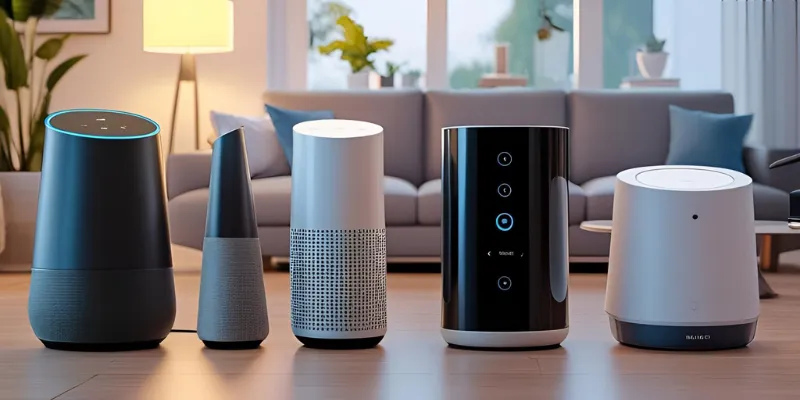
Image: Canvas
In addition to functionality, customization is a crucial differentiating factor for... virtual assistants at home. Each assistant has a "personality" that resonates with different profiles.
Alexa, for example, is a good fit for large families or multigenerational households.
Imagine a home with children and grandparents: Alexa can tell children's stories, patiently answer curious questions, and even help with medication reminders.
Her friendly voice and relaxed tone create a welcoming atmosphere, but she may seem less "serious" to professionals seeking technical answers.
Google Assistant, on the other hand, attracts analytical people, such as entrepreneurs or students.
Consider Pedro, a university student who uses the assistant to organize his study routine.
It sets alarms for deadlines, requests summaries of academic articles, and even allows for language practice with interactive responses.
Google's ability to learn from past interactions ensures that responses are increasingly aligned with your needs.
However, their more neutral approach may not appeal to those seeking a warmer interaction.
Siri, on the other hand, is perfect for minimalists or Apple fans.
Its integration with the brand's ecosystem creates a cohesive experience, but its reduced flexibility may frustrate users who expect advanced personalization.
An interesting statistic: according to Statista, in 2024, 351,300 of virtual assistant users will prefer devices that reflect their personality or lifestyle.
This reinforces the importance of choosing an assistant who not only performs tasks but also connects with you emotionally.
After all, who doesn't want an assistant who seems to understand their quirks?
Practical Considerations for Integration into the Home
Now, let's get down to practical matters: how do the virtual assistants at home Do they fit into your home's infrastructure?
Compatibility with smart devices is a decisive factor.
Alexa, for example, supports a wide range of devices, from Philips Hue light bulbs to August smart locks.
However, its initial setup may take time, especially in homes with many devices.
Additionally, the need for a central hub, such as the Echo Show, can increase the initial investment.
Google Assistant, on the other hand, is more accessible to those who already own Android devices or Chromecast.
Its setup is intuitive, and the integration with Google Home allows you to easily control multiple devices.
However, in homes with mixed infrastructure (such as Apple and Android devices), Google may face compatibility conflicts.
Siri, on the other hand, requires a robust Apple ecosystem, which may limit its usefulness in technologically diverse households.
Finally, privacy is a growing concern.
Siri leads in this regard, processing a lot of data locally, while Alexa and Google Assistant rely more on cloud servers, which may concern security-conscious users.
A helpful analogy: choosing a virtual assistant is like choosing a roommate.
You want someone trustworthy, who respects your space and adapts to your routines.
Before deciding, ask yourself: which assistant not only makes your life easier, but also respects your values and technological limitations?
Comparison of Virtual Assistants
|
Assistant |
Strengths |
Limitations |
Best for |
|---|---|---|---|
|
Alexa |
Wide compatibility, routine automation |
Less effective in complex research. |
Families, connected homes |
|
Google Assistant |
Advanced search, Google integration |
It depends on a stable internet connection. |
Professionals, students |
|
Crab |
Privacy, integration with Apple |
Less versatility in skills |
Apple users, minimalists |
Virtual assistants at home: Frequently Asked Questions
|
Question |
Response |
|---|---|
|
Which assistant is easier to set up? |
Google Assistant has an intuitive setup, especially for Android. |
|
Can I use assistants without internet access? |
Siri performs some functions offline; Alexa and Google rely on the internet. |
|
Which one is the safest in terms of privacy? |
Siri prioritizes privacy with local processing on Apple devices. |
|
Do they understand Brazilian Portuguese well? |
They all have good support, but Google Assistant leads in contextual understanding. |
Conclusion: virtual assistants at home
You virtual assistants at home They're not just tools; they're extensions of your lifestyle.
So, whether you're a family seeking connection, a professional needing efficiency, or a minimalist valuing privacy, there's an assistant to fit the bill.
Alexa charms with its versatility, Google Assistant impresses with its intelligence, and Siri wins over with its simplicity.
The choice depends on how you envision your home: an automation hub, a productivity center, or a safe haven.
So, which virtual assistant will transform your home into the perfect reflection of your lifestyle?