German forest intrigues because its trees appear to grow crooked.
The famous German forest It holds within the heart of Central Europe a vegetal anomaly that defies our most basic visual intuition.
Advertisements
Walking among these tree trunks is to encounter formations that bend at improbable angles right next to the ground, as if gravity had failed for a few moments.
Throughout this reading, you will understand the coordinates of this phenomenon, the current scientific debate, and why the human presence still intrigues researchers.
Summary
- Where is the German forest of crooked trees located, and what is its official name?
- What are the main hypotheses for the curved shape of the trunks?
- How do crooked trees affect biodiversity and the local ecosystem?
- What historical forestry techniques may have shaped the vegetation?
- Comparison: Natural raw material vs. anthropogenic molding
- How can I visit the reserve in a responsible and sustainable way?
- Conclusion
- Frequently Asked Questions (FAQ)
Where is the German forest of crooked trees located, and what is its official name?

The heart of this group lives in the vicinity of the Süntel hills, terrain where the Fagus sylvatica var. suentelensis It projects sinuous branches almost to foot level.
There is something almost sculptural about these trees with flattened crowns, whose structure defies the straight geometry we usually associate with healthy plant growth in dense forests.
The region's moist soil is home to these centuries-old specimens, requiring discreet fencing to prevent uncontrolled tourism from compacting the soil around the roots.
Unlike youth teams, the German forest It features specimens aged 100 to 180 years that carry valuable morphological scars for modern genetics.
The local temperate climate ensures the constant moisture necessary to sustain wood that has grown under intense mechanical stress and accumulated deformations over decades.
Mapping the location of these isolated reserves helps botanists collect rare seeds, safeguarding a biological heritage that nearly disappeared in the last century.
What are the main hypotheses for the curved shape of the trunks?
The most consistent botanical explanation points to a recessive mutation that deregulates auxin, the hormone responsible for guiding the vertical growth of plants.
Another line of reasoning prefers to blame the weight of past snowstorms or cutting winds that would have bent the seedlings at their most fragile stage.
However, field simulations show that isolated weather events would hardly create such standardized curvatures in dozens of beech trees scattered across the same hill.
Recent germination tests in isolated greenhouses have confirmed that some of these offspring inherit the sinuosity of their parents, even when grown in flat, protected soil.
To understand the urgency of preserving unique ecosystems like this one, it is worth consulting the collection of European Environment Agency, a global reference in ecological data.
Investigating these cellular orientation flaws provides valuable insights into how the plant kingdom adapts to small genetic mutations without losing its viability.
How do crooked trees affect biodiversity and the local ecosystem?
The contorted architecture of the beech trees in this German forest creates unique ecological niches, where the wrinkled bark provides constant shelter for rare mosses.
These deep folds retain rainwater for longer, creating small suspended reservoirs for beetles and arachnids that depend on microclimatic humidity.
Small birds take advantage of the density of low branches to build nests out of sight of large aerial predators in the region.
The forest floor around this area exhibits accelerated leaf decomposition, feeding the network of fungi that connects the underground root systems of this ecosystem.
The uneven distribution of sunlight through the twisted canopy allows for the emergence of ground cover plants that would never thrive in the shade of conventional BEECH trees.
Observing the dynamics of this ecosystem proves how physical deformities in the flora can, paradoxically, expand opportunities for shelter and food for the fauna.
Protecting this specific biodiversity ensures the continuity of sensitive food chains that depend directly on the decaying wood of these centuries-old beech trees.
++ Megalithic structures that still challenge modern engineers.
What historical forestry techniques may have shaped the vegetation?
An intriguing debate persists about the extent to which human intervention has shaped the initial design of this German forest over the preceding centuries.
During the 19th century, artisans and shipwrights hunted for naturally bent timbers to construct ship bows and heavy wheel supports.
The management known as copying It induced the curvature of young shoots through planned tying, facilitating the harvesting of pieces with a specific shape.
Although the genetic component is undeniable, the intervention of early farmers may have selected and multiplied the most crooked specimens for strictly utilitarian reasons.
Historical documents from Lower Saxony record the frequent extraction of these beech trees for the production of agricultural tools that required extremely high impact resistance.
The current result appears to be the meeting point between a spontaneous biological mutation and generations of rural workers shaping the forest around them.
Reading the growth rings reveals marks of ancient cuts, reinforcing the idea that human activity helped sculpt this landscape.
++ A 2,200-year-old shoe was found with its laces still preserved.
Comparison: Natural raw material vs. anthropogenic molding
The analysis below combines biological factors and human interventions to explain the existence of this unique vegetation in Germany.
| Analysis Parameter | Natural Genetic Mutation (Süntel-Buche) | Historical Human Intervention (Management) |
| Primary Cause | Alteration in auxin synthesis and distribution | Targeted pruning and mechanical tying |
| Heredity | Transmitted by seeds (recessive gene) | Not hereditary (purely physical effect) |
| Growth Pattern | Winding branches, low and twisted crown | Curvature concentrated only at the base. |
| Life expectancy | 120 to 160 years (weakened wood) | Variable, depending on the agricultural cut. |
| Main Occurrence | Süntel Reserve and Botanical Gardens | Areas of cultivation of old naval timber |
Why does the shape of these beech trees continue to intrigue science to this day?
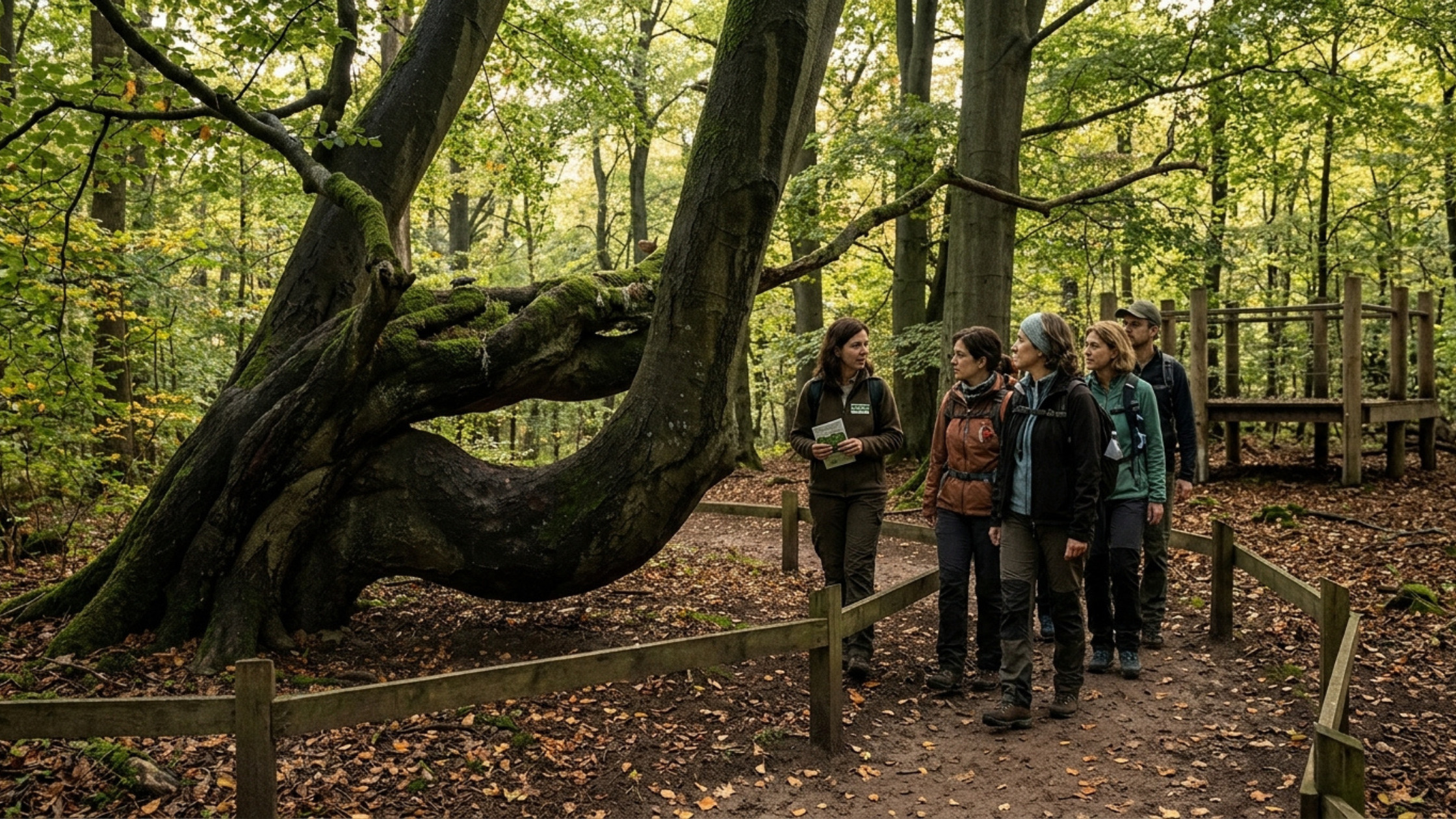
Even with advances in genetic mapping, the behavior of this vegetation continues to challenge biologists and botanists.
Observing the growth of these beech trees reveals that nature operates in unforeseen ways, creating forms that appear to have been hand-carved by invisible forces.
The fragile structure of these bent trees attracts the attention of researchers interested in plant biomechanics.
Trunks that grow in a twisted fashion suffer constant internal stress, which makes the survival of centenarian specimens a true enigma of physical resilience.
The restricted geographic distribution of these populations suggests that specific microclimatic factors act as catalysts for the phenomenon.
Small variations in soil composition and moisture gradient appear to favor the persistence of these anomalous characteristics across generations.
Preserving these unique ecosystems goes far beyond aesthetic curiosity or local tourist appeal.
Each gnarled trunk holds valuable records about the plants' ability to adapt to environmental stresses and rare genetic mutations in Central Europe.
++ The Mandela Effect: Why so many people remember non-existent facts.
How can I visit the reserve in a responsible and sustainable way?
The allure that surrounds this German forest It requires conscious behavior from travelers, as the impact of footsteps on the roots is a real risk.
Staying strictly on marked trails prevents the soil from losing the porosity necessary for rainwater to reach the surface roots.
Climbing tree trunks for photos is a destructive habit; the contorted structure of these beech trees is more fragile than it appears and poorly supports the load.
Capturing the beauty of a location requires discreet equipment, avoiding altering the surrounding vegetation simply to find the best photographic angle.
Using accredited guides enriches the tour with information about the local botanical history, as well as ensuring that park regulations are respected.
Responsible visitation is the only guarantee that this unusual ecosystem will remain strong, allowing future generations to also unravel its mysteries.
Planned tourism injects resources into local communities, enabling conservation research and the preventive fencing of areas with young, growing seedlings.
To understand the German government's efforts to protect forest areas, follow the work of... Federal Ministry for the Environment, a benchmark in the sector.
Conclusion
The mysterious German forest The twisted beech trees remain an invitation to reflect on the invisible forces that shape plant life around us.
Between rare genetic mutations and the silent traces of past artisanal management, each crooked tree trunk carries a story that deserves to be rigorously preserved.
Respecting the boundaries of this ecosystem when visiting it is the fundamental step in ensuring that this botanical heritage continues to intrigue scientists and travelers for many years to come.
Frequently Asked Questions (FAQ)
What is the average age of crooked trees in Germany?
Most centenarian specimens of the species Fagus sylvatica var. suentelensis It has an estimated developmental age of between 100 and 180 years.
Can crooked trees produce viable seeds?
Yes, twisted beech trees do produce seeds, but only a percentage of the offspring will exhibit the twisted phenotype due to the recessive nature of the mutation.
Is it permitted to visit the forest year-round?
Public reserves are open year-round, but visits in spring and autumn are recommended for better viewing of the vegetation.