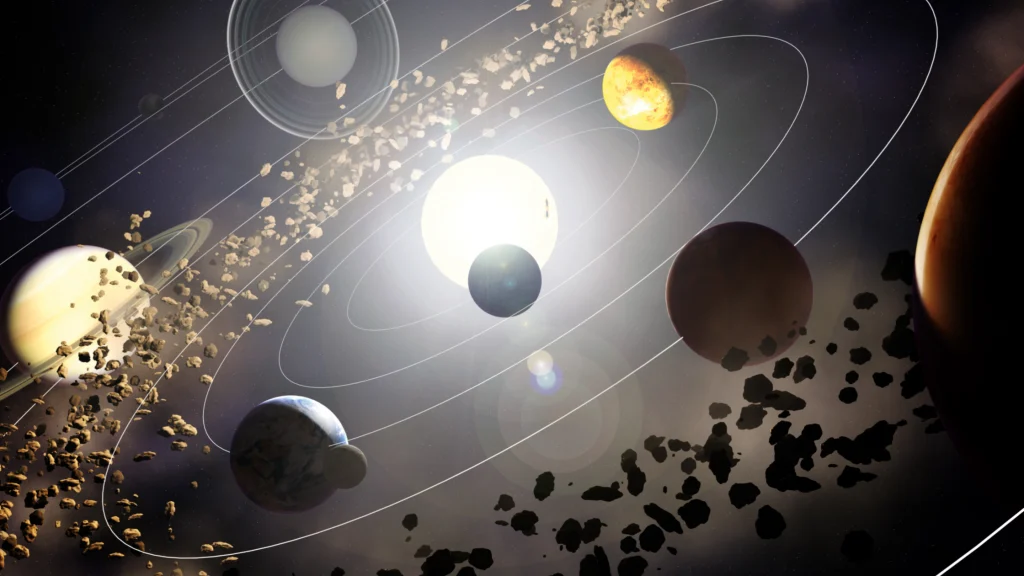
What science already knows about the possible Planet Nine.
Planet Nine It began as a mathematical suspicion.
Advertisements
There was no stunning photograph, spectacular announcement, or telescope pointed directly at a new world hidden in deep space.
The beginning was quieter — almost uncomfortably technical.
Some objects extremely distant from the Solar System were behaving strangely. Their orbits seemed too organized to be random.
It was like finding footprints in the snow without seeing who had been there.
And perhaps that's precisely what makes this hypothesis so fascinating: the possibility of a gigantic planet orbiting the Sun while remaining invisible for decades.
Continue reading the text!
Summary
- How did the hypothesis of this distant planet arise?
- What evidence makes scientists take the theory seriously?
- Why is the search so difficult?
- What would change if this planet were found?
- The most discussed theories about its origin.
- Comparison between this possible planet and others in the Solar System.
- Frequently Asked Questions
How did the hypothesis of this distant planet arise?
The story of Planet Nine He didn't start by observing a planet. He started by observing deviations.
Astronomers were analyzing trans-Neptunian objects — icy bodies far beyond Neptune's orbit — when they noticed something strange.
Some of these orbits were grouped in an improbable way, inclined in almost the same direction.
Coincidences happen in astronomy. But persistent patterns often raise suspicions.
It was then that the researchers and , linked to In 2016, they proposed a bold hypothesis: perhaps a massive planet was gravitationally influencing these distant objects.
The most interesting detail is that the Planet Nine It first emerged as a calculation, not as an image.
There's something almost ancient about it. Like 19th-century astronomers predicting Neptune before they even saw it.
Science sometimes works like a cosmic criminal investigation: no one sees the suspect directly, but the clues begin to point to someone.
Read also: How the discovery of a pterosaur reveals surprises from prehistoric science.
What evidence makes scientists take the theory seriously?
The hypothesis of Planet Nine It remains relevant because some orbital behaviors continue to be difficult to explain.
Certain distant objects appear to be grouped in a statistically unusual way.
It's not just visual alignment. The orbits exhibit specific gravitational patterns that suggest external influence.
According to analyses compiled by NASA Solar System Exploration, simulations indicate that a planet between five and ten times the mass of Earth could generate exactly this type of orbital perturbation.
And here a disturbing aspect emerges.
Humanity has already identified galaxies billions of light-years away. It has also observed black holes colliding.
Even so, perhaps there is a huge planet hidden within the Solar System itself, without definitive confirmation.
This is often misinterpreted as a technological failure. It is not.
The problem lies in the sheer scale of space. The outer Solar System is not a "neighborhood nearby." It's a nearly empty, dark, and gigantic territory.
++ The scientific mystery surrounding hidden oceans on distant moons.
Why is the search so difficult?
Find the Planet Nine It's a brutally complicated task. Not just because of the distance, but because of the combination of distance and darkness.
The most widely accepted estimates suggest that it could be between 400 and 800 astronomical units from the Sun.
For comparison: Neptune orbits at about 30 astronomical units.
This changes everything.
The sunlight that would reach that planet would be extremely weak.
And the light reflected back to the telescopes would be even less. In visual terms, it would almost disappear against the dark background of space.
There is also another, less discussed problem: movement.
Very distant objects appear to move too slowly in the sky.
In some observations, the displacement can be so small that it is mistaken for fixed stars in the background.
An analogy helps.
Search for Planet Nine It's like trying to find a firefly standing still in the middle of a dark stadium while observing everything through a tiny window.
And yet, astronomers continue searching.
++ Interesting things the body does during sleep.
What would change if this planet were confirmed?
Confirmation of Planet Nine It would have a much greater impact than simply "adding another planet" to the Solar System map.
It would force scientists to revise a significant portion of current models of planetary formation.
For decades, the Solar System was described as relatively organized after its initial formation.
But a massive planet so far away suggests a far more chaotic past.
Some theories suggest that gas giants may have migrated intensely billions of years ago, hurling objects into outer regions in a kind of colossal gravitational turbulence.
There is a romanticized image of space as something silent and stable.
The reality was probably closer to a slow-motion accident, full of collisions, ejections, and unpredictable trajectories.
In this scenario, the Planet Nine He would be almost an exiled survivor of that violent period.
What are the most widely discussed theories about its origin?
No hypothesis about the Planet Nine It's completely consensual. And that makes the debate even more interesting.
The strongest theory suggests that it formed near Jupiter, Saturn, Uranus, and Neptune before being flung into outer regions by gravitational interactions.
Another possibility is even stranger.
The planet may have been captured from another star system during the Sun's first few million years, when young stars were being born relatively close to each other.
It seems unlikely at first glance.
But the universe operates on such vast scales that rare events end up happening more frequently than human intuition would like to admit.
The studies from Caltech continue to be a benchmark in this debate precisely because they attempt to connect these hypotheses to current observable patterns.
And there's an important detail: even without direct observation, mathematical models continue to refine possible regions where this planet could be located.
Comparison between this possible planet and others in the Solar System.
| Feature | Earth | Neptune | Possible Planet Nine |
|---|---|---|---|
| Estimated mass | 1 Earth | 17 Lands | 5 to 10 plots |
| Distance from the Sun | 1 UA | 30 UA | 400 to 800 AU |
| Orbital time | 365 days | 165 years | Up to 20,000 years |
| Estimated temperature | Moderate | Very cold | Extremely cold |
| Direct observation | Confirmed | Confirmed | Still hypothetical |
Looking at these numbers evokes a curious feeling.
O Planet Nine It wouldn't just be "a little distant".
It would occupy an almost alien region of the Solar System itself, so remote that it defies even the intuitive notion of belonging to a planetary system.
Are there scientists who disagree with this hypothesis?
Yes. And honestly, it would be strange if there wasn't disagreement.
Some in the scientific community believe that the observed orbital patterns may be the result of statistical bias.
In other words, perhaps the available data is still insufficient to support such a grand conclusion.
Other researchers propose explanations involving collective groupings of small objects or gravitational effects that are still poorly understood.
This is often interpreted by the public as a sign of weakness in the hypothesis. But science doesn't operate on immediate unanimity.
On the contrary. Strong hypotheses survive precisely because they face rigorous criticism.
According to recent analyses by Scientific American, new telescopes and astronomical surveys may provide more solid answers in the coming years.
Or perhaps they will raise new questions. Which, in astronomy, often happens with disconcerting frequency.
Frequently Asked Questions
| Question | Response |
|---|---|
| Has Planet Nine ever been directly observed? | No. So far, its existence is based on indirect gravitational evidence. |
| What would be the estimated size of this planet? | Between five and ten times the mass of the Earth, according to the most widely accepted models. |
| Why hasn't he been found yet? | Primarily due to the enormous distance and low light levels. |
| Is there scientific consensus about its existence? | Not entirely. The hypothesis is considered plausible, but not yet confirmed. |
| Could this planet have an influence on Earth? | Not noticeably so due to the estimated extreme distance. |
There is something profoundly human about this quest.
Modern astronomy has enough technology to observe violent phenomena in distant galaxies, but it still stumbles upon shadows within the Solar System itself.
O Planet Nine Perhaps it exists. Perhaps it's just a temporary interpretation of incomplete patterns.
But the mere fact that this hypothesis remains alive already reveals something important: even surrounded by maps, calculations, and gigantic telescopes, there are still regions of the universe where science works almost like someone trying to hear footsteps in the dark.
Dig deeper:
++ What is known about the mystery of the 9th planet in the Solar System?