What were the gods of Egypt and what were their functions?
Advertisements
We're about to explore one of the world's ancient cultures! Come discover who the gods of Egypt were and what their roles were!
One of the most mysterious cultures, and one that generates the most curiosity among people unfamiliar with it, is undoubtedly the culture of Ancient Egypt.
Amidst all the customs and beliefs immortalized by the Egyptians, it is undeniable that an aura of mystery has been created around the habits they adopted and how society functioned at that time.
Among the topics that most attract the curiosity of the general public – such as the traditional pyramids, the curious stages of a mummification process, and the impressive sarcophagi where the most noble were buried – one that draws the most attention is Egyptian mythology and the gods that were part of it!
But who were the gods of Egypt, and what were their functions?
That's what we're going to find out in today's content! Here, we'll understand a little more about how the beliefs adopted by the Egyptians worked and what each of these gods represented to the people who lived in Ancient Egypt!
Why were there multiple gods in Ancient Egypt?
As you may already know, the belief system of the people of Ancient Egypt involved not just one, but several gods.
But do you know why this happened?
This happened because, unlike Christianity – which has only God as its belief, that is, monotheism – the Egyptian people became known for practicing polytheism.
Polytheism consists of the belief in and/or worship of more than one deity. And each of these entities possesses its own individuality and personality.
In other words, each of the gods worshipped by the people of Ancient Egypt – and by all religions and cultures that adopt polytheism – is known for governing their own areas and activities.
In addition to the culture of Ancient Egypt, religions such as Hinduism, Buddhism, Taoism, and some African tribal religions also adopt polytheism, dividing their beliefs among various gods and goddesses.
What were the gods of Egypt and what were their functions?
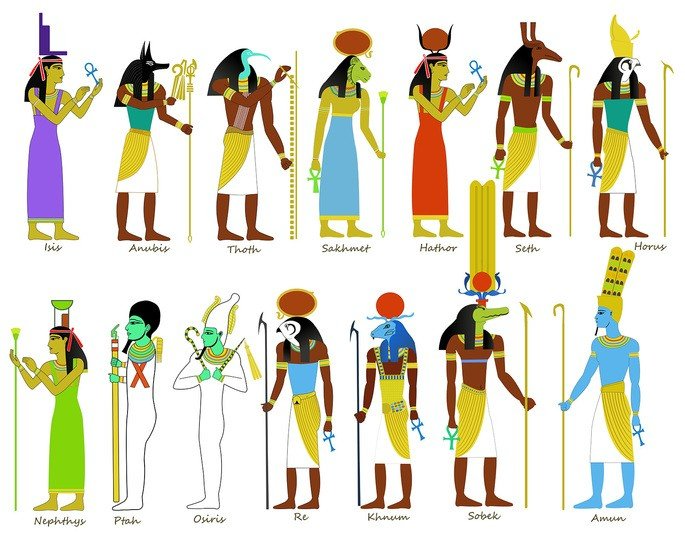
After understanding a little more about polytheism, it's time to delve into the main topic of today's text!
Next, you will discover who the gods of Egypt were – at least the most important ones for Egyptian culture – and what their functions were according to the beliefs of the people.
And before we begin, it's worth remembering another peculiarity of the religion. For the Egyptians, the representation of the gods – most of the time – was done by blending human and animal characteristics, giving the gods unique aspects.
Starting our list of Egyptian gods with Ra, one of the main gods of Egyptian mythology.
Beginning our list with one of the most important gods of Egypt, we have Ra. Known as the Sun God, Ra held a prominent position in the pantheon of Egyptian gods.
At one point in Egyptian history, Ra was considered the most powerful god and creator of the universe.
Represented by the form of a falcon, its role was to rule over the living and the dead.
Isis
While Ra was considered one of the most prominent gods in Egyptian mythology, Isis could easily be considered the most important goddess in Egypt.
Isis – whose name means "goddess of the throne" – lived up to her name, as the goddess was considered the mother of all pharaohs.
According to mythology, Isis was the one who helped the dead reach the much-desired afterlife.
Osiris
Another god who deserves a mention on our list is Osiris. According to Egyptian belief, Osiris was the god responsible for judging the dead in his court.
Furthermore, Osiris was also considered the god who taught early humans how to care for the soil and plant their food. And that is precisely why he came to be considered the god who invented agriculture.
According to mythology, he was killed by his brother Set, but was resurrected by Isis, his sister and wife.
Amon
Amon was also considered the god of the sun and air. According to Egyptian mythology, Amon was one of the most important gods in history and, like Ra, was also placed in a prominent position among the gods.
So much so that, at a certain point in the history of Ancient Egypt, a unification of the cults of Amun and Ra occurred. This union gave rise to the deity Amun-Ra.
Anubis
One of the most well-known gods in Egyptian mythology worldwide, Anubis is probably the most popular figure among the gods of Ancient Egypt.
Considered the god of the dead and sick, Anubis was believed to be responsible for guiding souls after death. Son of Osiris and Nephthys – another goddess who is part of Egyptian mythology – Anubis was represented by his human body and a jackal's head.
Horus
Considered the god of the pharaohs, the heavens, the living, and families, Horus was the figure responsible for the birth of each day.
Son of Isis and Osiris, Horus has always been depicted with the head of a falcon and the body of a man.
Seth
Representing chaos, war, darkness, and betrayal, Seth was Osiris's brother and was responsible for murdering Osiris.
According to mythology, the murder occurred after Seth discovered that Osiris had impregnated Nephthys, Seth's wife.
In mythology, Seth is represented by the body of a man and the characteristic head of an anteater.
These are just some of the main gods of Egypt. Besides these, there are many other gods who were responsible for various areas of the world.
Conclusion
So, were you already familiar with these Egyptian gods and their roles?
It's worth remembering that we've only listed some of the main gods of Egypt, since the Egyptian civilization believed in hundreds of gods who, in different ways, contributed to preserving the harmony of the Universe.
But anyway, with the information gathered here, we were able to explore this curious and nuanced religion a little more. And that's fascinating!
Did you enjoy today's content? Then take the opportunity to read also What was the importance of the Book of the Dead to the Egyptians?