
Does the Tasmanian Tiger still exist? Check out the latest records
Advertisements
Have you ever heard of the Tasmanian Tiger? And do the Tasmanian Tiger still exist?
As time passes and humanity becomes increasingly more developed, nature continues to surprise us and show us why it is so important to our existence.
And this is one of those cases! In this text, we will talk about an animal that was declared extinct in the first half of the last century.
But is this species really extinct? Or does the Tasmanian Tiger still exist?
That's what we're going to find out in this content! With comments from scientists, you'll learn more about this species that is new to our generation.
Meet the Tasmanian Tiger
You can admit it: when you read the term 'Tasmania' you automatically associate it with the Tasmanian Devil – or just Taz – the character that was part of the Bugs Bunny cartoons and that never stopped moving back in the 90s.
But, despite having the same 'surname', the Tasmanian Devil – the animal on which the character was inspired – and the Tasmanian Tiger are different animals.
And in this topic we will learn a little more about this animal.
Considered the largest carnivorous marsupial of modern times, the Tasmanian Tiger – which is also known as the Tasmanian Wolf – was an animal that lived in countries such as Australia and New Guinea.
With a very peculiar appearance, the animal did not look like a tiger, but rather a mix between a dog and a kangaroo.
Although it doesn't look like a feline, the name tiger was given because of its fur.
Varying between shades of yellowish-brown and gray, all animals of the species always had characteristic dark stripes.
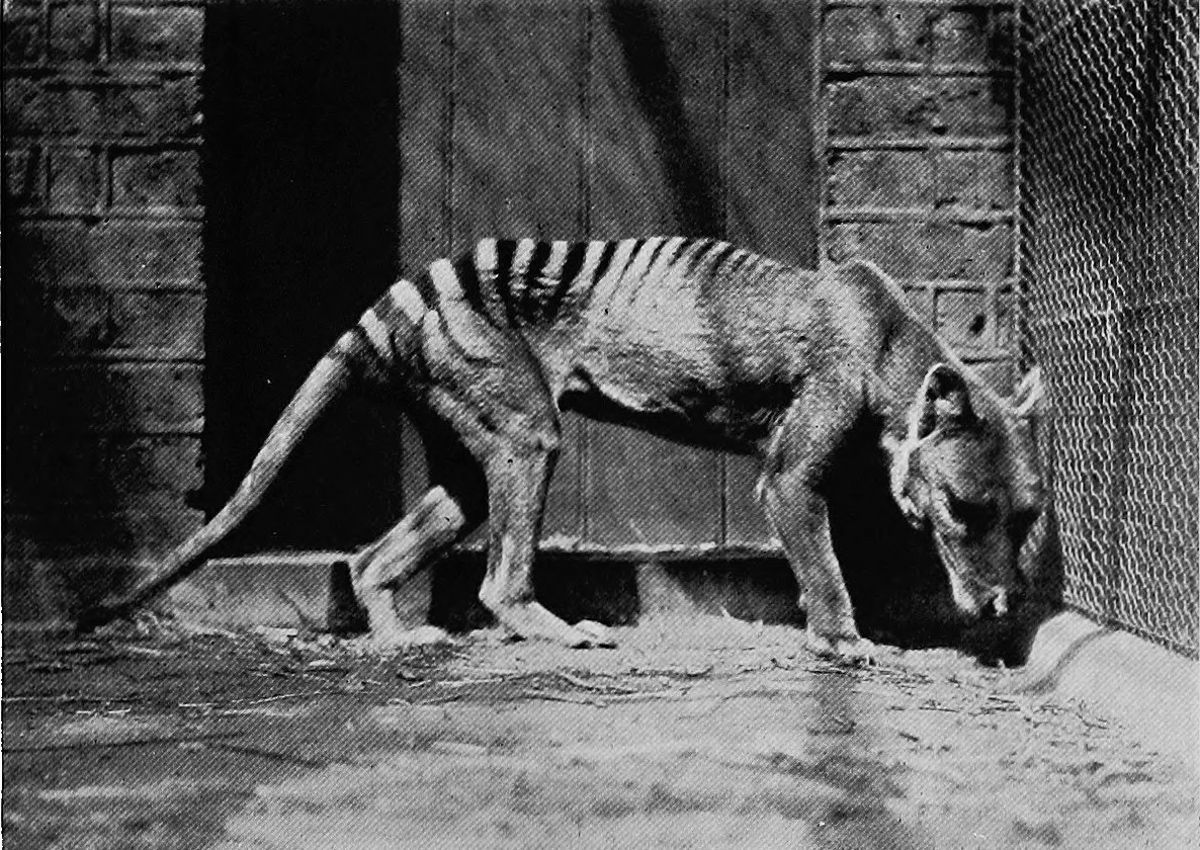
The last of its kind was recorded 90 years ago, in 1932. Because it is old, the photograph in question is black and white.
And this photographed specimen ended up dying 4 years later, in 1936.
Check out one of the last records of the species:
The reasons that caused the extinction of the species
It is difficult to pinpoint a single reason that caused the extinction of the species. But, without a shadow of a doubt, the main reason for the premature end of this species is human action.
Historians point out that the main factor for this to happen was intensive hunting.
For a long time, hunting of this animal was intense – and even encouraged with rewards.
This was because locals considered Tasmanian Tigers to be highly dangerous to their livestock.
And all this hunting was decisive in the extinction of the animals.
But, as mentioned at the beginning of the topic, other factors may also have contributed to this end.
Among them are: diseases of the species, the presence of dogs and the occupation of human beings where, until then, was the natural habitat of the species.
But is the Tasmanian Tiger really extinct? That's what we'll find out in the next topic!
Does the Tasmanian Tiger still exist?
Despite being declared extinct almost 100 years ago, this year the history of the Tasmanian Tiger gained a very important new chapter.
And much more than that, this new discovery can serve to bring hope to the species.
It turns out that new studies and records carried out in Australia suggest that there are still some living specimens of the Tasmanian Tiger.
This supposed theory arose after the release of a video made by Neil Waters.
Neil is the president of the Thylacine Awareness Group of Australia and recorded the video in late February this year.
Very excited about the possible discovery, Neil said he believes it is a family made up of a father, mother and a cub.
If this discovery proves to be true, it is expected that appropriate government action will be taken to protect this animal.
This way, if the species has actually reappeared, with the correct measures, it will be easier to protect this species from a second extinction.
And despite all the euphoria surrounding Neil Waters' supposed discovery, it's important to note that his account is not the first of its kind.
We'll talk more about this in the next topic!
Other alleged sightings that could indicate the existence of the Tasmanian Tiger
Although this supposed appearance was widely applauded and brought more hope for the reappearance of the Tasmanian Tiger, it is important to emphasize that this is not the first time that the species has been involved in situations like this.
This is because, according to data analyzed by professionals from the University of Tasmania, by 2019 more than 1,200 people had already reported encounters with animals that, according to them, were examples of the species.
In one of the reports collected, a group of cyclists approached the Australian authorities to report the sighting of an animal with a very different appearance.
Given the fact that the species went 'extinct' a long time ago, it would come as no surprise that the cyclists in question did not recognize the animals.
In another statement that is part of this University of Tasmania database, in 2019, a group of people also claimed to have seen an animal with a peculiar appearance.
After this brief encounter, they would have searched the internet for an image of the Tasmanian Tiger and, according to them, it was the same animal.
As much as they may seem like just disconnected testimonies and reports, this type of information helps to give even more strength to Neil Waters' report regarding the sightings of a family of Tasmanian Tigers.
Conclusion
So, what do you think of this story?
Even though it hasn't been confirmed yet, we're already rooting for Neil's discovery to be correct and for it to be a return of the species.
Because, when we come across a story like this, we can have a little more hope regarding the 'rediscovery' of so many other species around the world that have already been declared extinct, ensuring that they can have a new beginning.
Did you like this content? Then we believe you will also enjoy reading 10 documentaries about the animal kingdom
