World Whale and Dolphin Day: Raising awareness and protecting the species
Advertisements
THE World Whale and Dolphin Day, celebrated annually on July 23, is not just a commemorative date, but a global call to action.
This day highlights the urgency of protecting these marine mammals, whose existence is intrinsically linked to the health of the oceans.
In a world where marine ecosystems face unprecedented pressures, from pollution to climate change, raising awareness of the importance of whales and dolphins becomes crucial.
After all, why do we allow such majestic species, which have gone through centuries of evolution, to face the risk of disappearing under our watch?
Find out more below!
World Whale and Dolphin Day
These cetaceans, with their remarkable intelligence and fundamental ecological roles, are true sentinels of the seas.
Whales, for example, contribute to the nutrient cycle in the oceans, a process known as a "biological pump," where their deep dives and nutrient-rich feces fertilize plankton, the base of the marine food chain.
Dolphins, with their sociability and cognitive abilities, inspire research that expands our understanding of animal intelligence.
However, the survival of these species is threatened by human activities, which makes World Whale and Dolphin Day a time for reflection and mobilization.
In this text, we will explore the relevance of this date, the challenges faced by whales and dolphins, practical actions for their protection, and answers to the most common questions on the subject.
With an informative and argumentative approach, we seek not only to inform, but also to engage readers to become agents of change.
++ Hybrid animals: what they are and some species
After all, the preservation of these animals is, in essence, the preservation of the balance of the oceans and, by extension, of life on Earth.
The Importance of World Whale and Dolphin Day
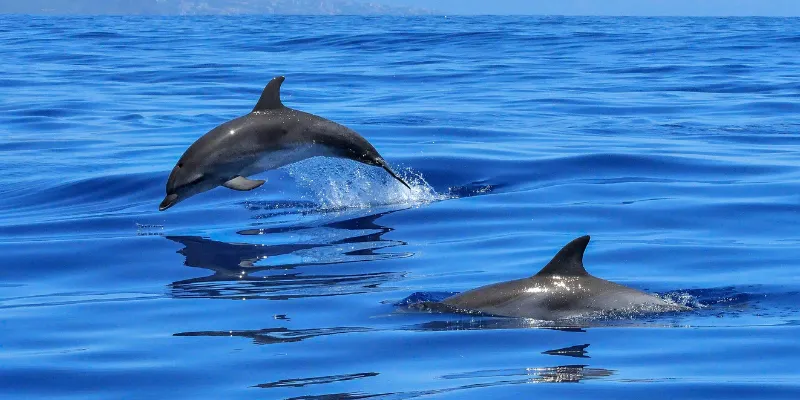
THE World Whale and Dolphin Day emerges as an initiative to highlight the interdependence between cetaceans and marine ecosystems.
Established to raise awareness of the threats these animals face, it also celebrates their ecological and cultural importance.
++ Animals That Change Color and How They Do It
For example, in coastal communities like Hawaii, humpback whales are seen as symbols of spiritual connection to the sea, inspiring local traditions that reinforce the need to protect them.
Thus, the date serves as a bridge between science, culture and conservation.
Additionally, whales and dolphins play crucial roles in regulating ocean ecosystems.
When whales dive and surface, they transport essential nutrients from the ocean floor to the surface, promoting the growth of phytoplankton.
This process not only sustains the food chain, but also contributes to carbon capture, helping to mitigate climate change.
A staggering statistic reveals that a single whale can sequester about 33 tons of carbon dioxide over its lifetime, equivalent to the emissions of an average car over years.
Therefore, protecting these animals is investing in the health of the planet.
Ultimately, World Whale and Dolphin Day is an opportunity to educate and engage.
The date encourages collective actions, such as beach cleanup campaigns or petitions against harmful practices, such as commercial hunting.
Imagine the oceans as an orchestra: each species, like whales and dolphins, is an indispensable musician.
Therefore, if we lose these “musicians,” the harmony of the ecosystem collapses.
Thus, the celebration of this date invites us to reflect: what are we doing to ensure that the symphony of the seas continues to echo?
Challenges to the Survival of Whales and Dolphins
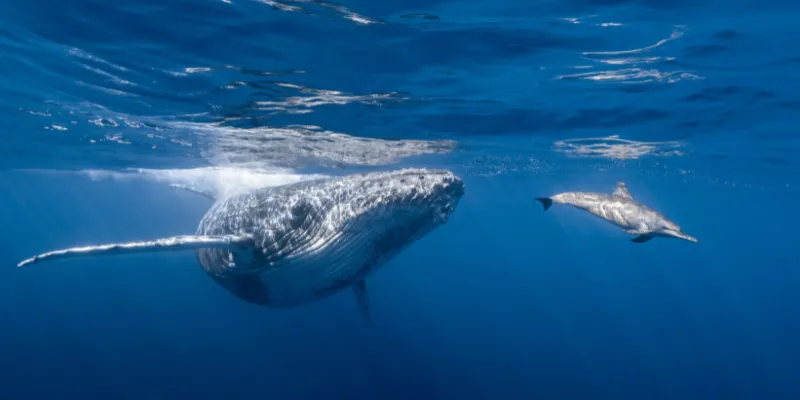
Image: Canva
Despite their importance, whales and dolphins face increasing threats.
Ocean pollution, especially from plastics, is one of the biggest challenges.
Microplastics ingested by these animals compromise their health, causing everything from digestive problems to death.
A striking example occurred in 2019, when a whale was found in the Philippines with 40 kilograms of plastic in its stomach, a tragic reminder of human negligence.
++ Animals with Superpowers: Amazing Abilities That Nature Created
Therefore, combating plastic pollution is an urgent priority for conservation.
Furthermore, overfishing and accidental capture in fishing nets, known as “bycatch,” threaten entire populations.
Dolphins, for example, are often trapped in trawl nets, suffering serious injuries or death.
Data from the Food and Agriculture Organization of the United Nations (FAO) estimates that around 300,000 cetaceans die annually due to bycatch.
This alarming number underscores the need for stricter regulations and sustainable fishing technologies, such as nets with exclusion devices.
In this sense, climate change also worsens the situation.
Warming oceans alter the distribution of prey such as krill and small fish, forcing whales and dolphins to migrate to less safe areas or face food shortages.
Furthermore, ocean acidification compromises coral ecosystems, essential habitats for many species that make up the dolphins' diet.
Given these challenges, World Whale and Dolphin Day reinforces the urgency of global policies that promote sustainability and marine protection.
|
Threat |
Impact on Cetaceans |
Proposed Solutions |
|---|---|---|
|
Plastic Pollution |
Ingestion of microplastics, death by obstruction |
Reduction of single-use plastics, recycling |
|
Bycatch |
Injuries or death in fishing nets |
Networks with exclusion devices, regulation |
|
Climate Change |
Food shortages, risky migrations |
Emission mitigation, habitat protection |
Practical Actions for the Protection of Whales and Dolphins
Protecting whales and dolphins requires concrete actions, and the World Whale and Dolphin Day is the ideal time to mobilize efforts.
An inspiring example comes from New Zealand, where local volunteers created “Operation Moana,” a project that combines environmental education with monitoring dolphin populations.
This type of initiative demonstrates how communities can come together to protect local species by promoting awareness and collecting scientific data.
Furthermore, individuals can contribute by adopting sustainable practices in their daily lives.
Reducing the use of disposable plastics, supporting brands that use sustainable fishing nets, and participating in beach cleanups are accessible and impactful actions.
For example, the “Adopt a Reef” campaign in Brazil encourages divers to monitor coral reefs, crucial dolphin feeding habitats.
In this sense, these actions, although small, create a cascade effect, expanding the protection of marine ecosystems.
Finally, pressure for public policies is essential.
Supporting organizations that fight for marine protected areas (MPAs) and demanding regulations against commercial whaling are fundamental steps.
In short, in the global context, countries like Australia have already implemented MPAs that protect whale migration routes, serving as a model.
Thus, World Whale and Dolphin Day is not just a day for reflection, but an invitation for everyone to take an active role in conservation.
|
Action |
Description |
Expected Impact |
|---|---|---|
|
Plastic Reduction |
Use of reusable items, support recycling |
Less pollution in the oceans |
|
Community Monitoring |
Projects like “Operation Moana” |
Data for conservation, local awareness |
|
Support for Protected Areas |
Pressure for MPA policies |
Protection of habitats and migratory routes |
Frequently Asked Questions about World Whale and Dolphin Day
|
Question |
Response |
|---|---|
|
When is World Whale and Dolphin Day celebrated? |
Celebrated annually on July 23, the date aims to raise awareness about the protection of these cetaceans. |
|
Why are whales and dolphins important? |
They regulate marine ecosystems, like the whales' "biological pump," and inspire scientific advances. |
|
How can I help with conservation? |
Reduce plastics, support sustainable fisheries, and participate in marine protection campaigns. |
|
What are the biggest threats to these animals? |
Pollution, bycatch, climate change and commercial hunting are the main challenges. |
|
Are there international laws to protect them? |
Yes, like the International Whaling Commission moratorium, but enforcement varies by country. |
Conclusion: A Call to Action
THE World Whale and Dolphin Day is more than a celebration; it is a reminder of our shared responsibility.
Protecting whales and dolphins means preserving the oceans, which cover 70% of the planet and sustain life as we know it.
Every action, no matter how small, contributes to a future where these animals continue to swim freely, singing their songs and maintaining the harmony of the seas.
So get involved: join campaigns, educate yourself, and push for change.
Like a whale diving from the depths to bring nutrients to the surface, each individual effort can emerge as a powerful force for conservation.
So, what will you do today to ensure that whales and dolphins continue to delight future generations?