Interesting facts about clouds and little-known atmospheric phenomena.
Little-known atmospheric phenomena They transform any old sky into something that makes you pull the car over to the side of the road or look up in the middle of the street.
Advertisements
While most people only see passing clouds, there are formations that look like they came from another planet, revealing an atmosphere far wilder and more unpredictable than we imagine.
These events are not mere whims of the weather.
They expose layers of extreme physics — ice crystals floating where air is almost nonexistent, light bending in ways that defy intuition.
The curious thing is that, even with satellites monitoring everything, we still miss a good part of the spectacle because it happens too fast, too far away, or simply above our everyday line of sight.
Continue reading the text.
Summary
- What makes some little-known atmospheric phenomena So intriguing?
- How are the rarest clouds we see in the sky formed?
- Why the little-known atmospheric phenomena Do they still surprise scientists?
- What are the most striking examples of little-known atmospheric phenomena?
- Frequently asked questions about little-known atmospheric phenomena
What makes some little-known atmospheric phenomena So intriguing?
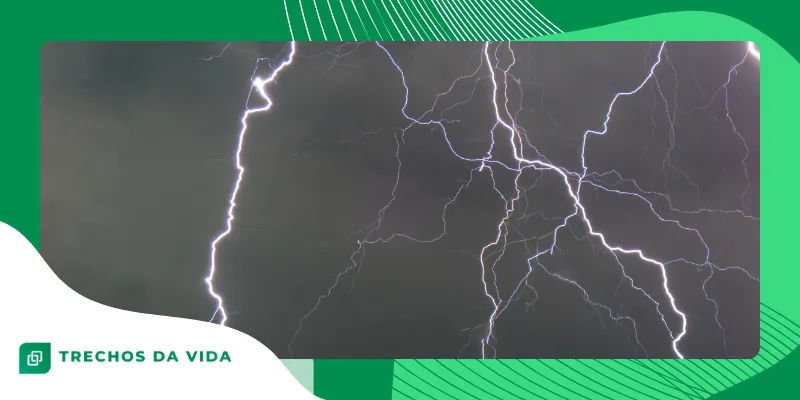
The atmosphere acts like an invisible ocean, with currents, layers, and boundaries that rarely reveal its chaos.
Many little-known atmospheric phenomena They emerge precisely at these unstable edges: where stratospheric cold meets barely reaching sunlight, or when contrary winds create ripples that resemble waves breaking in reverse.
There's something unsettling about that.
Despite all the technology we point at the sky, these details escape us because the atmosphere changes on scales of minutes and kilometers that our instruments still capture incompletely.
What we see is just the tip of the iceberg — or rather, the crest of the highest wave.
This reminds us that the sky is not a passive backdrop.
It is a living process, full of interactions that influence everything from the regional climate to how we perceive daylight.
Those who begin to pay attention discover that the ordinary often hides the extraordinary more frequently than expected.
Read also: Interesting facts about the human intestine that you never imagined were true.
How are the rarest clouds we see in the sky formed?
Most clouds are formed from moist air rising and cooling.
Rare species require more demanding ingredients: temperatures that plummet below -80°C, tiny, uniform particles, or winds that create stationary patterns against mountains or cold fronts.
Asperitas, for example, appear when a stable layer of clouds is agitated by air currents coming from opposite directions, generating chaotic undulations that resemble the seabed seen from below.
Officially recognized by the World Meteorological Organization only in 2017, they show how ordinary observers still help to classify what official science was slow to accept.
Nacreous, or pearly, clouds form in the polar stratosphere during the harsh winter.
Tiny ice crystals more than 20 km above the horizon act like prisms, scattering sunlight that hasn't yet reached the horizon and creating soft, painted shades of pink, green, and orange.
++ Natural Phenomena That Seem Supernatural, But Have Partial Scientific Explanations
Why the little-known atmospheric phenomena Do they still surprise scientists?
The surprise comes from the combination of rarity and technical complexity.
Many of these events are short-lived and occur in remote regions or at altitudes inaccessible for routine measurements.
Satellites help, but they don't replace the human eye or instruments carried by research aircraft.
Some little-known atmospheric phenomena They are also connected to larger changes.
Noctilucent clouds, the highest clouds on Earth, appear to be becoming more visible at lower latitudes—possibly due to changes in water vapor in the mesosphere.
This raises subtle questions about how human activities reverberate in layers that previously seemed untouched.
Imagine the atmosphere as a seemingly calm lake: on the surface everything appears tranquil, but deep currents create eddies that only appear occasionally.
Those little-known atmospheric phenomena It is precisely these swirling currents that come to light and force us to rethink what we thought we understood.
++ The Science Behind Déjà Vu: Brain Malfunction or Protective Mechanism?
What are the most striking examples of little-known atmospheric phenomena?
Mammatus clouds appear as pouches or udders hanging at the base of thunderstorms, formed when cold, dense air sinks into pockets within the cloud.
The dramatic scenery often precedes severe weather, although it is no guarantee of immediate rain.
They transform the sky into something almost organic, as if the cloud were breathing.
The glory, or halo, is another highlight: a colorful ring that appears around the shadow of an airplane or mountain projected onto the clouds.
It is formed by the diffraction of light in water droplets of very similar size.
Those who travel by plane frequently are more likely to spot it, but the full explanation still involves nuances of dispersal that go beyond the basics.
Records compiled by observers and the World Meteorological Organization indicate that formations such as asperitas and nacreous appear in less than 1% of routine observations in mid-latitudes, reinforcing how fleeting they are even in the age of instant photography.
Original examples of little-known atmospheric phenomena in everyday life
During a car trip through the interior of São Paulo, amidst a cold front arriving in the late afternoon, a driver noticed clouds with irregular undulations that resembled ocean waves seen from below.
They were asperites forming on altocumulus clouds disturbed by high-altitude winds.
He stopped, took a photograph, and only later understood that he was witnessing a formation that official science took decades to name.
The sky didn't promise a violent storm, but it showed the atmosphere in a subtle and beautiful imbalance.
On another occasion, during a hike in the mountains of southern Brazil at dawn, a group saw a luminous circle around their own shadows projected onto the dense fog of the valley.
It was a glory cloud: the droplets in the mist were similar enough in size to create almost perfect diffraction.
The effect lasted only a few minutes, but left the feeling that the observer was, for a moment, at the center of something larger and more delicate.
These moments don't require sophisticated equipment. They only require curiosity and the habit of looking up.
Many little-known atmospheric phenomena They are discovered exactly like that — by ordinary people who decided to pay attention.
Frequently asked questions about little-known atmospheric phenomena
| Question | Practical answer |
|---|---|
| Do mammatus clouds signal immediate danger? | They indicate instability in the storm, but do not cause direct damage. |
| Is it possible to see nacreous clouds in Brazil? | Very rare, usually only found in more southerly latitudes during harsh winters. |
| What produces the colors in pearly clouds? | Diffraction of light in tiny ice crystals in the extremely cold stratosphere. |
| Does Asperitas always precede heavy rain? | Not necessarily. It reflects turbulence, but it's not a reliable forecast of precipitation. |
| What is the difference between glory and halo solar? | Glory appears around the observer's shadow; a halo is a larger circle around the sun or moon. |
How to observe better the little-known atmospheric phenomena
Pay special attention to transition times — dawn, dusk, or right after cold fronts pass.
Weather apps help identify favorable conditions, such as intense cold at high altitudes or lenticular clouds over mountainous terrain.
Always record the time, the exact location, and the conditions at that moment.
Cloud-watching communities exchange images and help with identification.
Over time, what seemed random becomes a pattern that we begin to recognize.
You little-known atmospheric phenomena They remind us that the sky is not just decoration.
It is an ongoing process, full of details that reward those who patiently look up.
In times when screens are everywhere, there are still genuine surprises waiting up there.
For those who want to delve deeper:
- International Cloud Atlas – World Meteorological Organization
- Unusual cloud formations – Met Office UK
Next little-known atmospheric phenomena It may be forming right now above you. Just look.