How the discovery of a pterosaur reveals surprises from prehistoric science.
Advertisements
THE Pterosaur discovery reveals surprises of prehistoric science. in a way that affects us.
A small, seemingly insignificant fossil found in Arizona reveals how these winged reptiles were already flying over joined continents much earlier than most people imagined.
It's not just another old bone — it's a reminder that the past still holds tricks capable of turning our certainties upside down.
That Pterosaur discovery reveals surprises. that go beyond the isolated fossil.
It captures a moment of ecological transition, where ancient creatures shared space with evolutionary novelties that would later take over.
What follows is a more honest conversation about these findings, without romanticizing them too much, but acknowledging how much they challenge what we thought we knew.
Keep reading the text!
Summary
- What does the recent discovery in the Late Triassic really tell us?
- Why do pterosaurs remain so rare in the fossil record?
- How are the Brazilian findings changing the global picture?
- What surprising adaptations have these animals developed?
- Frequently Asked Questions about Pterosaurs and their Discoveries
What does the recent discovery in the Late Triassic really tell us?
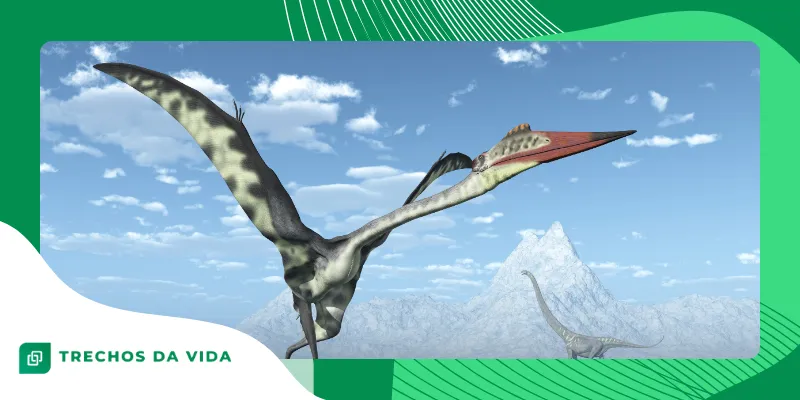
The discovery of a pterosaur reveals surprises from prehistoric science. This is especially clear with Eotephradactylus mcintireae.
This small reptile, about the size of a seagull, lived approximately 209 million years ago in what is now the Petrified Forest National Park in Arizona.
The main material is a jawbone with teeth still in place — enough to show that it fed on fish with hard scales in seasonal rivers.
The environment was semi-arid, close to the equator, crisscrossed by river channels that suffered severe flooding.
These floods quickly buried animals, creating a momentary "freeze" of an entire ecosystem.
Along with the pterosaur, primitive turtles, giant amphibians, ancient frogs, and relatives of armored crocodiles appeared.
There's something unsettling about this: a world where the old and the new coexisted in a messy way, without the clean narrative we sometimes invent for evolution.
The discovery of a pterosaur reveals surprises from prehistoric science. This is also because this animal was already exploring the interior of continents, far from the coastal margins where most early pterosaurs appear in Europe.
At the time, everything was still Pangaea. Flight was probably the key to surviving the great extinction that would come soon after, 201.5 million years ago.
While many groups disappeared, these flying creatures were able to escape and recolonize devastated areas.
Paleontologists like Ben Kligman point out that the site shows a real transition: ancient groups coexisting with "newcomers" who would later dominate.
Ultimately, evolution has never been a straight line—it's been more of a tangled web of experiments happening simultaneously.
Read also: Interesting facts about animals that seem unbelievable, but are true.
Why do pterosaurs remain so rare in the fossil record?
Their bones were delicate, their bodies light, and their lifestyle aerial. All of this makes fossilization an unlikely stroke of luck. Most lived in places where sediments did not preserve well—far from calm lakes or tranquil seas.
The discovery of a pterosaur reveals surprises from prehistoric science. just when we manage to overcome these barriers.
Techniques such as computed tomography (CT) scans extract details from fragments that would otherwise be overlooked.
In the case of Arizona, the jawbone revealed not only the new species, but also clear evidence of its diet and habitat.
Think of them as restless travelers from an ancient world.
They flew everywhere, but only left traces when they fell under very specific conditions.
This rarity doesn't mean they were scarce during their lifetime. On the contrary, they dominated the skies for over 160 million years.
In Brazil, rock formations like Romualdo offer superior windows thanks to the calcareous concretions that preserve fine details.
These are exceptions that help fill in a global puzzle.
++ The scientific mystery surrounding hidden oceans on distant moons.
How are the Brazilian findings changing the global picture?
Brazil has been generous with pterosaurs from the Cretaceous period.
Bakiribu waridza, described from a regurgitalite—essentially fossilized vomit—is surprising for being a filter feeder of plankton and small organisms, the first clear record of this type in tropical latitudes of Gondwana.
The discovery of a pterosaur reveals surprises from prehistoric science. also in these South American findings.
Bakiribu exhibits a mixture of European and South American features, suggesting more complex biogeographical connections than previously thought during the Cretaceous period.
Another fascinating case is Galgadraco zephyrius, an azhdarchid from the Upper Cretaceous found in the Bauru Group.
Their similarities to Romanian forms indicate that these long-necked animals occupied similar niches on continents that were already separating.
These Brazilian fossils demonstrate diversity in low-latitude environments, where the fossil record is usually poorer.
They complicate simplistic narratives about how life spread.
++ The mystery of the world of rare black hole explosions.
What surprising adaptations have these animals developed?
Pterosaurs invented active flight independently of birds and bats.
Evidence from terrestrial relatives, such as lagerpetids, suggests that the neural basis for flight arose early.
More than 200 species have already been described, with wingspans ranging from less than one meter to more than ten meters.
This enormous variation reveals an impressive adaptive radiation.
The discovery of a pterosaur reveals surprises from prehistoric science. It appears in extreme dietary specializations: brush-like teeth for filtering, toothless beaks for catching fish, crests that could serve for display or aerodynamics.
Could it be that we are still underestimating how sophisticated these reptiles were?
Imagine a filter feeder like the Bakiribu dipping its beak into shallow water, sifting like a tiny, ancient version of a whale.
It required flexible jaws and strong teeth — an ingenious solution for a specific niche.
Or consider the azhdarchids: not all of them had absurdly long necks.
Some more robust forms suggest opportunistic terrestrial hunters, allowing several species to coexist in the same place without directly competing.
Table: Comparison of Recent Pterosaur Discoveries
| Species | Location | Approximate Age | Main Feature | What is surprising |
|---|---|---|---|---|
| Eotephradactylus mcintireae | Arizona, USA | 209 Ma (Triassic) | Jaw with teeth, small size | Early continental distribution |
| Bakiribu waridza | Ceará, Brazil | Cretaceous (Aptian-Albian) | Filter feeder, preserved in regurgitalite. | First clear tropical record |
| Galgadraco zephyrius | Minas Gerais, Brazil | Late Cretaceous | Azhdarchid with ties to Europe | Distant biogeographical connections |
Frequently Asked Questions
Question: Were pterosaurs dinosaurs?
Response: No. They were flying archosaurs, on a separate evolutionary line, although closely related.
Question: How many pterosaurs have been found in Brazil?
Response: Dozens of species, especially in the Araripe Basin, which has become a world reference.
Question: Why do new species still emerge?
Response: Re-analyses using modern technology and new findings in the field continue to reveal what was previously hidden.
Question: Could they fly long distances?
Response: Evidence points to sustained flight and migration capabilities, which aided survival during unstable times.
The discovery of a pterosaur reveals surprises from prehistoric science. Because each new fragment forces us to rethink timelines, distributions, and capabilities.
These animals survived dramatic changes thanks to their versatility.
Studying them is not just about curiosity about the past — it's about better understanding how life reinvents itself on an unpredictable planet.
And the most intriguing thing is: the best may still be hidden in remote rocks or in museum drawers that no one has looked at carefully enough.
The prehistoric sky remains full of secrets.
++ The pterosaur brain reinvented flight from scratch, reveals a fossil found in Brazil.