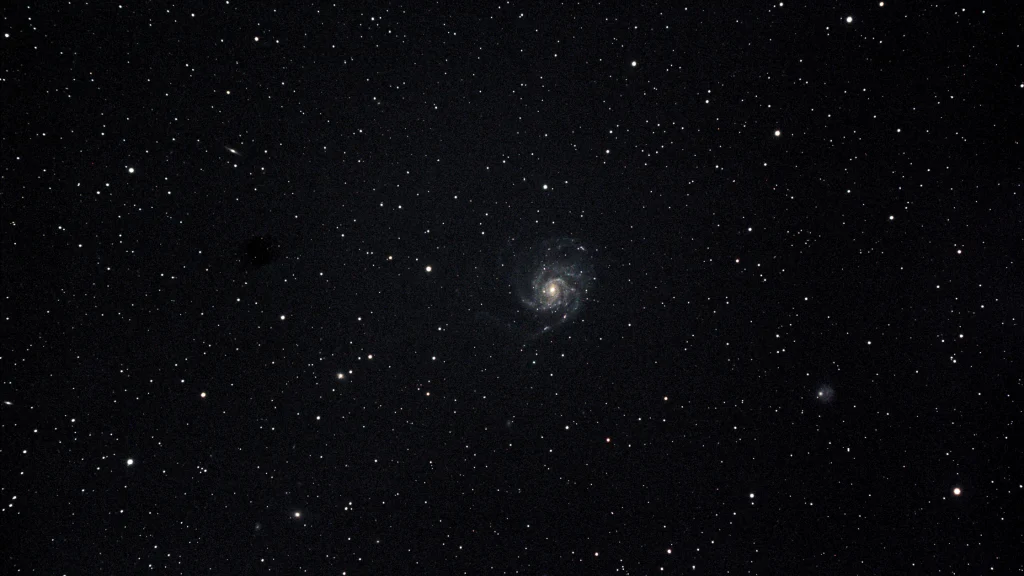
Beta Pictoris d: the new gas giant and what it reveals about the chaos of young systems.
Advertisements
Observational astronomy has just reached a fascinating turning point with the confirmation of a new exoplanet in the noisy, young system. Beta Pictoris.
Far from being just another addition to the exoplanet catalog, the finding exposes the analytical complexity required to see through violent cosmic scenarios.
Extracting this type of signal requires almost surgical precision. The system's central star shines with such intensity that any nearby planet risks becoming a mere luminous mirage, not to mention the dense circumstellar dust disk that acts as a smokescreen.
By isolating the planet's direct thermal emission via mid-infrared spectroscopy, Webb's team achieved something extraordinary: separating the noise of the dust from the actual chemical signature of this giant.
Summary
- How did the James Webb Telescope identify Beta Pictoris d?
- What are the physical and orbital characteristics of the planet Beta Pictoris d?
- Comparative Table of Exoplanets of the Beta Pictoris System
- Why did the atmospheric chemistry of Beta Pictoris d surprise scientists?
- What is the impact of this discovery on contemporary astrophysics?
- Frequently Asked Questions (FAQ) about Beta Pictoris d
- The final overview
How did the James Webb Telescope identify Beta Pictoris d?
The method employed by JWST is far removed from traditional transit techniques — where the planet merely “shadows” the star as it passes in front of it.
To find Beta Pictoris d, The researchers used direct imaging combined with coronary imaging and spectroscopy.
The strategy consisted of mechanically blocking the blinding light from the parent star in order to capture the faint, yet distinct, light emitted by the planet itself.
There's something fascinating about how this data has been refined. The protoplanetary disk around Beta Pictoris is a chaotic environment, teeming with asteroid collisions and debris on a gigantic scale.
Isolating meant applying spatial filtering algorithms capable of distinguishing the planet's intrinsic heat from the diffuse heat spread by billions of tons of fine dust.
Independent confirmation of the signal by different research groups has ruled out the hypothesis of a simple optical artifact.
What are the physical and orbital characteristics of the planet Beta Pictoris d?
It orbits at a distance of 26 to 30 astronomical units from its star — a stretch of space that bears striking analogies to Neptune's orbit around our Sun.
This substantial distance results in a planetary year that stretches for about nine Earth decades. Despite its youth, its atmospheric temperature hovers around 600 Kelvin (approximately 327 °C).
This is a surprisingly mild value when compared to its inner "siblings," revealing that the planet has already dissipated much of the extreme gravitational energy generated during its primary accretion phase.
Another point that draws the attention of theorists is orbital stability.
The trajectory of Beta Pictoris d It aligns almost perfectly with the plane of the debris disk, signaling that, despite the system's turbulent youth, the planet maintained a harmonious gravitational coexistence with the other two known giants.
++ How to Recover Deleted Files on Android and iPhone
Comparative Table of Exoplanets of the Beta Pictoris System
Compare Beta Pictoris d Interactions with its system neighbors help paint a clearer picture of how mass and energy are distributed around the host star over time.
| Physical Property / Orbital | Beta Pictoris b | Beta Pictoris c | Beta Pictoris d |
| Mass (in Jupiter masses) | ~9 to 11 $M_J$ | ~8.9 $M_J$ | ~2.4 $M_J$ |
| Distance Semi-major axis | ~10.1 AU | ~2.7 AU | ~26.0 AU |
| Estimated Radius | ~1.46 $R_J$ | ~1,2 $R_J$ | ~1.26 $R_J$ |
| Effective Temperature | ~1,700 K | ~1.250 K | ~600 K |
| Orbital Period | ~21 years old | ~3.3 years | ~91 years old |
For details on observational data from the Beta Pictoris system, see the publications of European Space Agency (ESO)They offer an indispensable technical collection.
Why did the atmospheric chemistry of Beta Pictoris d surprise scientists?
Spectral reading of the atmosphere of Beta Pictoris d It brought surprises that challenge simplistic models of education.
The telescope identified clear traces of carbon monoxide ($CO$), water vapor ($H_2O$), methane ($CH_4$), and a notable amount of carbon dioxide ($CO_2$).
It is precisely this dense signature of $CO_2$ that gives the planet's spectrum a rather unique reddish hue.
The abundance of elements heavier than helium and hydrogen indicates that the planet not only absorbed the gas around it, but also ingested massive quantities of rocky and icy planetesimals during its formation.
This behavior strongly supports the core-based accretion model, in which a dense skeleton of rock and ice thermodynamically attracts its gaseous envelope.
There is also something intriguing about the coexistence of methane and carbon monoxide in this temperature range.
This combination suggests the presence of a vigorous vertical circulation: deep, warm internal winds appear to push molecules into the upper layers faster than chemical reactions can destroy them, keeping the atmosphere in a perpetual state of imbalance.
++ How Science Is Transforming Waste into Fuel
What is the impact of this discovery on contemporary astrophysics?
Identify Beta Pictoris d This consolidates the system as one of the rare natural laboratories where we can observe multiple giant planets directly orbiting the same star.
There is incalculable value in analyzing worlds born from the same initial material, but subjected to such distinct thermal and orbital conditions.
There is also a clear methodological gain. The successful detection demonstrates that current technology can extract signals from moderate-mass exoplanets even when they are immersed in highly noisy dust disks.
This achievement paves the way for the search for even smaller and more distant planets in other neighboring systems.
Ultimately, understanding the architecture of Beta Pictoris forces us to recalibrate the simulation models of our own past.
By observing the gravitational forces and dust collisions that shape Beta Pictoris d, We glimpse the same chaotic processes that, four billion years ago, organized the planets of the Solar System.
How did the space telescope manage to overcome the barrier of interstellar dust?

The ability to penetrate dense clouds of debris and capture the light emitted from forming worlds revolutionized modern astrophysics.
Instead of relying on the temporary blocking of starlight during a transit, state-of-the-art instruments use thermal filters to isolate the infrared radiation emitted by the celestial body's own heat.
This breakthrough allows us to map the structure of young systems with a clarity that seemed impossible just a few decades ago, revealing crucial details about the composition and dynamics of these chaotic regions of the cosmos.
Furthermore, detailed analysis of this cosmic environment allows for practical testing of the accuracy of computational models that attempt to predict the fate of newly formed planetary systems.
When we observe these gas giants interacting in real time with the debris disk around them, we gather fundamental clues to understanding how distant worlds shape their own orbits over astronomical eras.
++ Why are the oceans changing color in some regions?
Frequently Asked Questions (FAQ) about Beta Pictoris d
What exactly is the exoplanet Beta Pictoris d?
This is a giant gas exoplanet recently characterized by the James Webb Space Telescope, located on the outskirts of the young Beta Pictoris star system.
How far is this system located from Earth?
The system is located approximately 63.4 light-years away from us, in the constellation of the Painter's Easel (Pictor).
How many planets have been confirmed in the system so far?
So far, three giant worlds have been confirmed by direct and indirect methods: Beta Pictoris b, Beta Pictoris ce Beta Pictoris d.
Is there any possibility of life on Beta Pictoris d?
No. Beta Pictoris d It is a gas giant without a solid surface, enveloped by a turbulent, high-pressure, and chemically inhospitable atmosphere.
What made the James Webb telescope crucial in this detection?
Its sensitivity in the infrared, combined with advanced coronagraphs, made it possible to mask the star's brightness and capture the faint thermal emission from the planet.
The final overview
The characterization of Beta Pictoris d The discovery by the James Webb Space Telescope is not an isolated event, but a symptom of an astronomy that has finally learned to see through the dust.
The ability to dissect the atmosphere and orbital mechanics of such a distant world demonstrates the maturity of our observational instruments.
This gas giant not only fills a gap in the map of the Beta Pictoris system, but also offers a fascinating glimpse into the raw forces that sculpt matter in the universe.
The study of the cosmos remains a constant exercise in humility and recalibration.
To keep up with the progress of space missions and official observation reports, it's worth consulting the portal of NASA Science.