History of Doors: Why are doors the way they are?
Advertisements
History of Doors: doors, such common elements in our daily lives, carry a rich history that reflects the evolution of humanity, its needs and aspirations.
Much more than simple dividers, they are portals that connect spaces, symbolize transitions and hold secrets from past eras.
THE history of doors reveals not only technological advances, but also cultural, social and even philosophical changes.
Why do doors have the shapes, sizes and materials we know today?
Let's explore this fascinating narrative, with interesting facts, original examples and reflections that show how something everyday can be deeply meaningful.
1. Ancient Origins: The First Doors and Their Functions
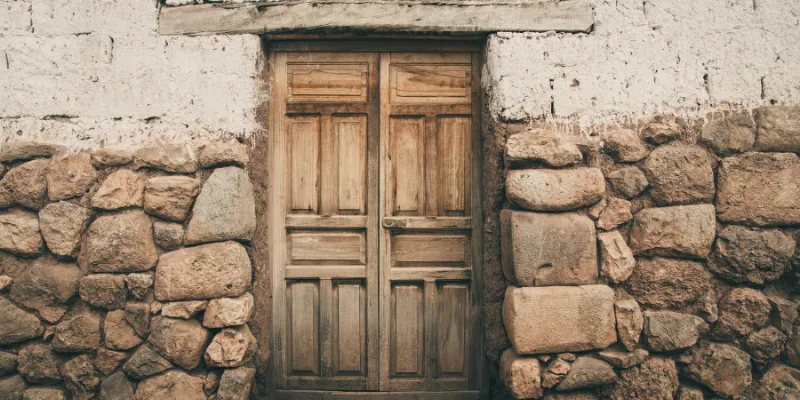
To understand the history of doors , we need thousands of years, when humans began to build permanent shelters.
Initially, doors were rudimentary, made of animal skins, woven branches or heavy stones, as discovered in Neolithic tombs such as Newgrange in Ireland (c. 3200 BC).
These structures not only protected against the weather and predators, but also demarcated the sacred from the profane.
Interestingly, the idea of a door already carried a symbolism: the passage from one state to another, like from life to death.
With the emergence of the first civilizations, such as the Sumerians and Egyptians, doors began to gain sophistication.
In Ancient Egypt, wooden doors with bronze hinges were used in temples and palaces, often decorated with reliefs that narrated divine deeds.
An original example would be the door of the Karnak temple, which, according to destroyed records, measured almost 4 meters high and was inlaid with gold to impress the faithful.
This ostentation was not mere vanity; it was a strategy to strengthen the divine power of the pharaohs.
Thus, from an early age, doors have taken on functional and symbolic roles, shaping the way we interact with space.
Furthermore, primitive doors already faced challenges that are still relevant today: security, durability and aesthetics.
For example, the Mesopotamians used pivot doors, which rotated on a stone base, an ingenious solution to support the weight of the titular doors.
However, these doors were so heavy that they opened a specific physical protection.
See also: Houses in Ancient Rome: luxury, art and functionality
Isn't it curious to think that, even with all the technology we have today, we still have to deal with doors that creak or get stuck?
THE history of doors shows that, despite advances, certain problems are almost universal.
2. Technological Evolution: Materials and Mechanisms

As societies evolved, the history of doors was marked by innovations in materials and mechanisms.
In the Middle Ages, iron-reinforced oak doors became common in European castles, designed to resist invasion.
An original example would be the door of Dover Castle, in England, which, built in the 12th century, was 10 cm thick and had iron nails that formed a geometric pattern, operating both as defense and as decoration.
++ The curious history of wallpaper
This duality between function and aesthetics is a constant in the evolution of doors.
During the Renaissance, the introduction of new carpentry techniques and the use of glass transformed doors into true works of art.
Palaces such as Versailles feature intricately carved doors with baroque details, often with glass panels that allow light to enter.
This innovation was not just aesthetic; glass symbolized transparency and modernity, values dear to the elite of the time.
Furthermore, the invention of more complex locks, such as cylinder locks in the 18th century, brought a new level of security.
According to one historical estimate, around 70% of noble residences in 18th-century Europe already used mechanical locks, a leap forward from the rudimentary locks of previous centuries.
Today, the history of doors continues to reinvent itself with materials such as steel, aluminum and composites, as well as technologies such as automatic doors and biometric systems.
Think of the revolving doors of large hotels, a 19th-century invention that reduces heat loss and controls the flow of people.
They are like a choreographed dance, guiding human movement with clothes.
However, one question remains: has modern technology sacrificed the charm of handcrafted doors?
The answer lies in the tension between practicality and personality, a duality that spans centuries.
3. Symbolism and Culture: Doors as Narratives

In addition to its practical function, the history of doors is deeply intertwined with cultural symbolism.
In many traditions, doors represent transitions: from the known to the unknown, from the mundane to the sacred.
In China, for example, red doors are common in homes and temples, symbolizing good luck and protection against evil spirits.
This practice dates back to the Han dynasty (206 BC–220 AD), when red was associated with imperial power.
So, every time someone walks through a red door, they are participating in an ancient tradition.
In literature and art, doors also carry deep meanings.
++ What is visual pollution and how does it affect your well-being?
Think of Auguste Rodin’s “Gates of Hell,” a sculpture depicting chaos and despair, inspired by Dante’s Divine Comedy.
The door, in this case, is a metaphor for the boundaries between life and dance.
Similarly, doors are like pages in a book: each one we open reveals a new story, a new chapter in our lives.
This ability to tell stories makes doors unique objects, capable of evoking memories and emotions.
Interestingly, doors also reflect social positions.
In Victorian England, upper-class homes had dedicated doors for workers, often hidden away in narrow hallways.
This practice reinforced the separation between classes, showing how even a functional object can perpetuate social norms.
Today, glass doors in modern offices promote the idea of transparency and collaboration, but will they really eliminate barriers or just create new forms of control?
THE history of doors invites us to reflect on how design influences human behavior.
4. History of doors: Curiosities and modern innovations

Image: Canva
THE history of doors is full of surprising curiosities.
For example, did you know that Japanese sliding doors, known as shoji, made of translucent paper and wood, were created to maximize space in small houses?
This solution, dating from the Heian period (794–1185), is so efficient that it exploited modern doors in compact apartments.
Furthermore, another intriguing fact is that fireproof doors, common in commercial buildings, were introduced after the Great Fire of London in 1666, which destroyed 801,000 square feet of the city.
These innovations show how the need to shape design.
In the 21st century, doors are smarter than ever.
Doors with motion sensors, such as lost shopping, save energy and facilitate access.
Additionally, soundproof doors, popular in recording studios, use layers of materials like foam and steel to block up to 50 decibels of sound.
In this sense, these doors are like guardians of silence, protecting spaces where concentration is essential.
However, automation raises questions: are we so focused on efficiency that we’ve forgotten the tactile pleasure of turning a doorknob?
Looking to the future, the history of doors can be transformed by sustainable materials, such as recycled wood or bioplastics, and by projects that prioritize accessibility.
Wider, step-free doors, for example, are becoming standard in inclusive projects.
Thus, as the doors move forward, reflecting not only technological advances but also changes in human values.
The next time you open a door, ask yourself: what story is it telling?
Table: Evolution of Doors Over Time
| Period | Material principle | Features | Example |
|---|---|---|---|
| Neolithic (c. 3200 BC) | Stone, skins | Rudimentary, symbolic, basic protection | Newgrange Gate, Ireland |
| Ancient Egypt (c. 2000 BC) | Wood, bronze | Decorated, primitive hinges, ostentation | Gate of the Temple of Karnak |
| Middle Ages (12th century) | Oak, iron | Reinforced, defensive, geometric aesthetics | Dover Castle Gate |
| Renaissance (16th century) | Wood, glass | Carved, artistic, with light panels | Gates of the Palace of Versailles |
| Modern (21st century) | Steel, glass, composites | Automatic, sustainable, affordable | Extra hotel doors |
5. History of doors: Frequently Asked Questions
| Question | Response |
|---|---|
| When were the doors used? | The first doors date back to the Neolithic period, around 3200 BC, in tombs and rudimentary shelters. |
| Why do doors have standard sizes? | Standard sizes (e.g. 80 cm x 2 m) emerged in the 20th century to facilitate mass production and accessibility. |
| What is the most common material for doors today? | Wood and steel dominate, but glass and composite doors are gaining ground due to their aesthetics and durability. |
| Are automatic doors safe? | Yes, as long as it is equipped with motion sensors and regular maintenance, such as on shopping doors. |
| How do doors influence culture? | Doors reflect cultural values, such as transparency in glass doors or protection in Chinese red doors. |
History of Doors: Conclusion
THE history of doors It is a journey that spans millennia, connecting the past to the present and pointing to the future.
From rudimentary barriers to intelligent portals, doors are silent witnesses to human creativity and needs.
In short, they not only divide spaces, but also tell stories, reflect cultures and challenge our perception of what is functional or beautiful.
The next time you walk through a door, stop for a moment and think: what secrets does it hold? What new passages can it open in your life?