Orangutan mothers organize playdates for their offspring to play together.
For decades, biology treated orangutans as the great hermits of the Asian forests, but observing orangutan mothers In nature, this idea is dismantled with a silent elegance.
Advertisements
There is something profoundly familiar about the way these females alter their solitary routes high in the treetops just so their offspring can play with their neighbors.
This is not an accidental encounter in front of a tree laden with figs, but a deliberate maternal plan—a kind of suspended playground leisurely organized in the middle of the jungle.
Summary
- How do orangutan mothers coordinate these encounters in the forest?
- Where did the researchers observe this social behavior?
- Why is play between puppies vital for survival?
- What skills do young primates develop during these meetings?
- How long does each meeting organized by the women last?
- What is the role of vocalization in communication between mothers?
- How does environmental degradation threaten these maternal social networks?
- Closing
- Frequently Asked Questions (FAQ)
How do orangutan mothers coordinate these encounters in the forest?
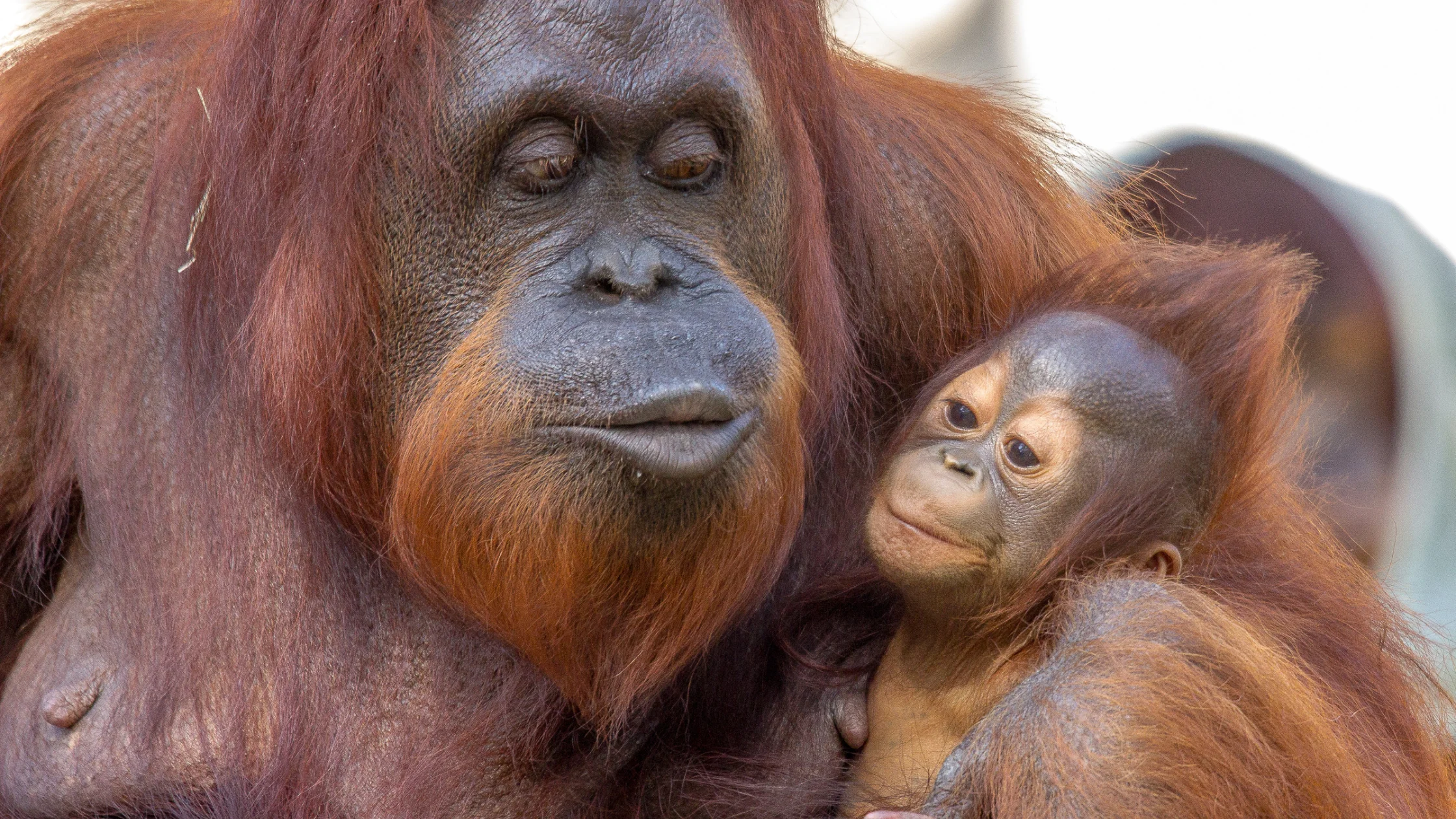
Unlike chimpanzees or gorillas, which live immersed in noisy herd politics, the orangutan has to deal with a stingy forest, where fruits ripen in a scattered and unpredictable way.
This is often misinterpreted as pure antisocial behavior, when in fact it is simply energy conservation in an environment that discourages permanent gatherings.
Still, when they raise their little ones, orangutan mothers They bend this ecological rule and adjust their pace, slowing their walk through the treetops when they sense another female with offspring nearby.
They carry a detailed mental map of their neighbors and know exactly where their territories intersect, using this knowledge to foster gatherings that defy the logic of isolation.
When they meet in clearings under leafy canopies, territorial tension disappears; the adults chew leaves peacefully while the young ones tumble down to the lower branches and begin an acrobatic racket.
While the young test their limits, the mothers act as quiet sentinels, keeping one eye on predators and the other on the feeding routine.
Where did the researchers observe this social behavior?
This subtle choreography only came to light thanks to the almost stubborn patience of field teams based at the Tuanan station in the Mawas reserve, in Central Borneo.
For more than fifteen years, biologists affiliated with the University of Zurich have been monitoring wild populations of Pongo pygmaeus wurmbii from before dawn until the construction of the night nests.
In these humid forests, scientists recorded distances, route deviations, and exact minutes of interaction, noticing that encounters occurred even when there was food available in opposite directions.
The numbers ultimately debunked the old theory of chance: those females were, in fact, setting a timer so that the next generation wouldn't grow up too isolated.
++ Lost a photo, video or file? Where to look first on Android and iPhone
Why is play between puppies vital for survival?
No other mother among terrestrial mammals invests as much time in a single offspring as the female orangutan, whose care extends for seven, eight, sometimes nine long years.
A childhood so extended requires more than milk and shelter; the developing brain needs the unpredictable chaos that only another young person of the same age can offer.
No matter how patient she is, a heavy, cautious adult can never simulate the erratic agility of a playmate.
This is precisely where the efforts of the orangutan mothers take on evolutionary meaning: by bringing their offspring together, they create a practical laboratory of applied physics thirty meters above the ground.
Chases among vines and simulated fights build muscles, calibrate balance, and teach the body to calculate the weight that each thin branch can withstand before giving way.
Those who grow up without this youthful rehearsal risk becoming awkward adults—both in crossing the canopy and in reading the intentions of a rival or partner in the future.
++ German forest intrigues because its trees appear to grow crooked.
What skills do young primates develop during these meetings?
Amidst what appears to be mere mess among the leaves, the puppies absorb an invisible curriculum of social rules and survival techniques.
Field records show that temporary cohabitation between families unlocks skills that would hardly emerge in the isolation of the mother-child pair:
- Moderation of force: Young people discover in practice how far they can go in biting or pushing a classmate without turning the game into a serious fight.
- Reading signs: Body postures and quick glances begin to function as a silent language to negotiate space and ask for a truce.
- Useful espionage: A puppy watches its older neighbor open a thorny fruit or fish for termites with a stick and takes the trick home.
- Emotional control: Dealing with someone outside the family circle reduces fear of the unknown, preparing the ground for adult life.
- Spatial awareness: Improvised jumps during a chase refine reflexes and depth perception at heights.
The table below contrasts the usual solitary routine with the dynamics observed during these maternal associations in the treetops.
| Behavioral Parameter | Standard Solitary Routine | Meetings Organized by Mothers | Impact on Youth Development |
| Distance between adults | Greater than 50 meters | Between 5 and 15 meters | Reduction of social stress and tolerance |
| Main activity of the puppies | Individual exploration and rest | Simulated fight and tree chase | Motor enhancement and force control |
| Maternal energy expenditure | Focused on continuous foraging | Extended breaks for surveillance | Direct investment in social education |
| Average duration of the interaction | Less than 15 minutes (occasional) | Between 2 and 6 consecutive hours | Strengthening relationships and learning. |
| Frequency of vocalizations | Low (only occasional alerts) | Moderate (also called gentle contact) | Refinement of acoustic communication |
As studies from the evolutionary anthropology department of [the institution] point out... University of Zurich, In this group of primates, motherhood functions as a cultural bridge between generations.
How long does each meeting organized by the women last?
The timing of these gatherings is dictated by the stomach and the calendar of fruits: when the forest is bountiful, families can spend up to six hours at a time in the same treetop.
During leaner months, the pace changes and the visit shortens to an hour or two, enough time for a quick round of playtime before hunger forces them back to foraging for food.
Among neighbors without close blood ties, the encounter is more subdued, but it serves the same purpose of refreshing the children's routine.
Interestingly, it is the females themselves who end their shift when they realize that the pups have spent all their energy and begin to yawn on the branches.
Without fanfare, each one gathers its offspring and follows distinct aerial trails, leaving the forest to once again plunge into its usual silence.
++ A 2,200-year-old shoe was found with its laces still preserved.
What is the role of vocalization in communication between mothers?
Even before their eyes meet through the thick foliage, these females are already conversing in an almost intimate tone, a far cry from the theatrical roars of the adult males.
While males use long calls to announce dominance from miles away, females opt for low grunts and soft lip clicks.
During playtime in the heights, the pups themselves provide the soundtrack with a kind of panting laugh — a universal code among primates to say that that bite on the shoulder is just play.
If the excitement gets out of hand and a little one lets out a high-pitched squeal of fright, the mother's intervention is immediate, a dry warning sound being enough to calm things down.
It's a sophisticated acoustic tag, designed to avoid conflicts on a stage where any misstep means a serious fall.
How does environmental degradation threaten these maternal social networks?
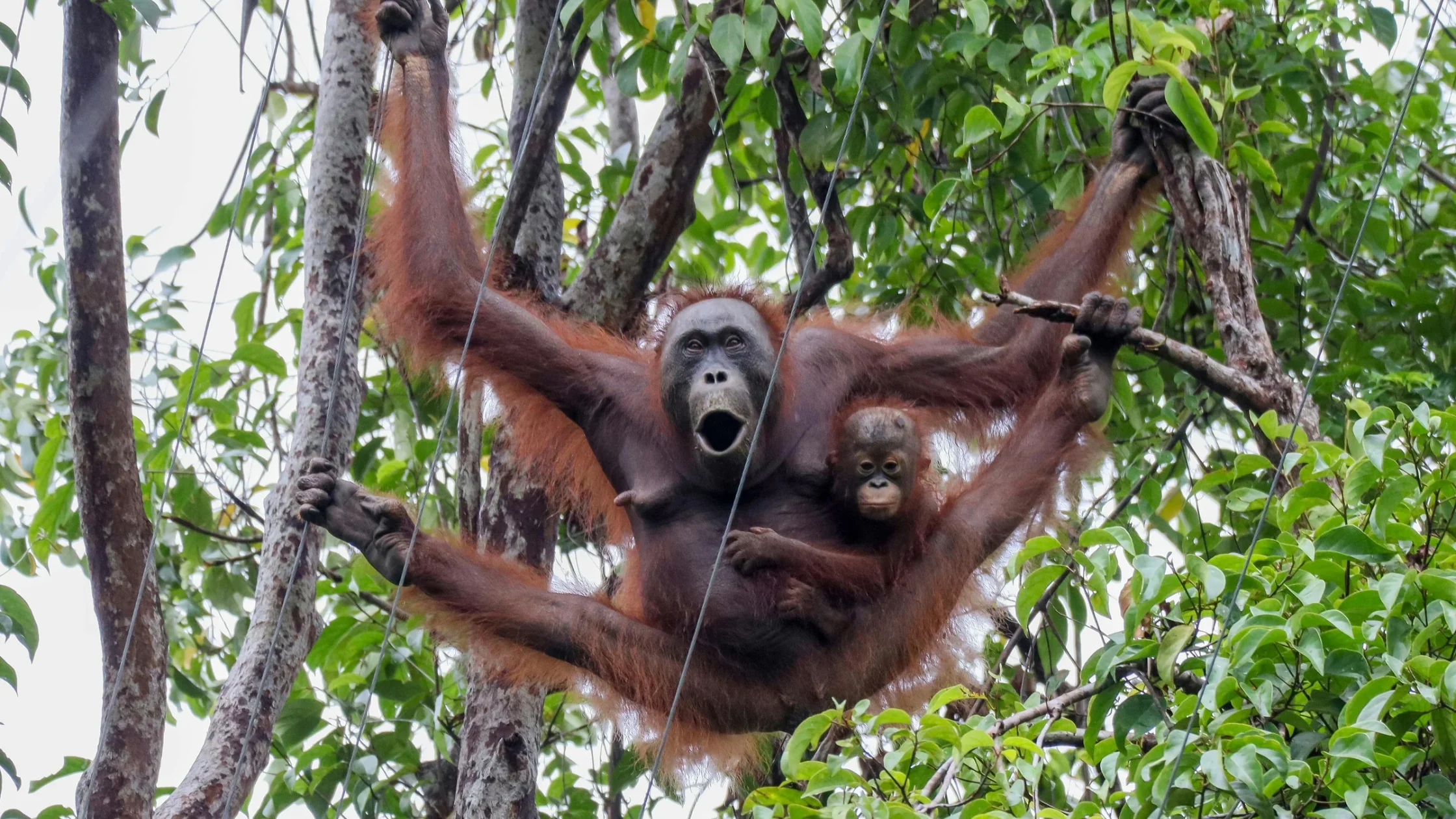
There is something unsettling about discovering the richness of this social life just as the forests of Borneo and Sumatra are shrinking under the encroachment of monocultures and illegal logging.
When a road or plantation cuts through the forest, it doesn't just fell centuries-old trees; it cuts off the invisible corridors through which these families visited each other.
Trapped on isolated islands of vegetation, orangutan mothers They lose contact with their neighbors and see opportunities for socialization for their offspring disappear.
Researchers have noted that isolated groups become culturally impoverished, losing local foraging techniques that were previously passed down from one family to another during these encounters.
Even worse: in depleted forests, searching for calories consumes the entire day, robbing them of the free time that made leisure and play possible.
According to surveys by International Union for Conservation of Nature (IUCN), All known orangutan species remain critically endangered.
Saving these primates requires more than preserving isolated patches of green; it means maintaining the entire forest architecture where their social stories unfold.
Closing
Observe orangutan mothers Detouring from their paths to ensure the companionship of a mate for their offspring forces science to reconsider old preconceptions about solitude in nature.
Behind the reserved appearance of these great apes lies a silent network of cooperation, memory, and care that sustains the learning of each new generation.
Ultimately, protecting the treetops where these gatherings take place is about preserving one of the oldest and most moving forms of social intelligence on the planet.
Frequently Asked Questions (FAQ)
Why don't orangutans live in large groups like chimpanzees or gorillas?
Because fruit trees in Asian forests bear fruit in a very scattered and irregular way, it would be impossible to feed a large group in the same place without constant disputes.
At what age do baby orangutans begin participating in these gatherings?
The first curious encounters occur around the age of one and a half, but it is between the ages of three and six that they truly engage in acrobatic play with their neighbors.
Do adult males also participate in these gatherings organized by the mothers?
No; adult males lead a much more solitary life and are usually avoided by females with offspring, as their presence can generate tension or risks for the young.
How do scientists know that the encounters are intentional and not accidental?
By cross-referencing tracking data and hours of observation, biologists have proven that females change their route to meet each other even when there are other trees full of fruit in opposite directions.
Do orangutan mothers play with the offspring of other females?
Almost never; the role of the adults is to ensure safety, rest, or pick parasites off each other, leaving the fun in the branches exclusively to the young.