
What is the oldest rock art in the world?
Advertisements
A quick question: do you know what rock art is?
Despite being a term that almost everyone has heard at some point in their life – especially during elementary school – there is still a lot of doubt regarding what exactly rock art is.
And it was with this in mind that we decided to create this content that you are about to read!
In this material, you will discover what exactly rock art is and its importance to our history.
And what's more, here you will also discover the oldest rock art in the world that we know of.
In other words: today's material will be a real lesson for anyone interested in historical facts and who wants to know more about this area!
What is rock art?
Rock art is also recognized as the oldest aesthetic and artistic manifestation of man since the dawn of humanity.
Most rock art was made during the prehistoric period – mainly between the Paleolithic (40,000 BC) and Neolithic (10,000 to 6,000 BC).
The word cave art comes from French and means something like “engraving” or “tracing” in free translation. This type of art is characterized by paintings and engravings.
The name given to this type of artistic expression is directly linked to the techniques used during the period in which these records were made.
Typically found inside caves, caverns and even in small sculptures, rock art is of enormous importance in the search for information about our past.
Furthermore, this type of discovery also helps us better understand how prehistoric man viewed the world in which he lived.
How important is rock art?
The truth is that it is practically impossible to measure the importance that this type of discovery has for humanity.
Although many people do not see this importance, it is essential that we know how to recognize it.
The controversy surrounding rock art
Like any topic involving history, rock art could not be free from controversy.
Some experts in the field still resist the idea of classifying this type of painting as a type of art.
According to them, this type of classification is not possible due to the uncertainty regarding the meaning of the arts. Many of them argue that it is impossible to be completely certain that the paintings themselves really deal with some representational or aesthetic meaning.
And it is worth remembering that, contrary to what many people may think, rock art is not something that is exclusively found in the Prehistoric period.
Recent research has concluded that this model of rock art has developed over time, passing through different periods of human history and development.
What is the oldest rock art in the world?
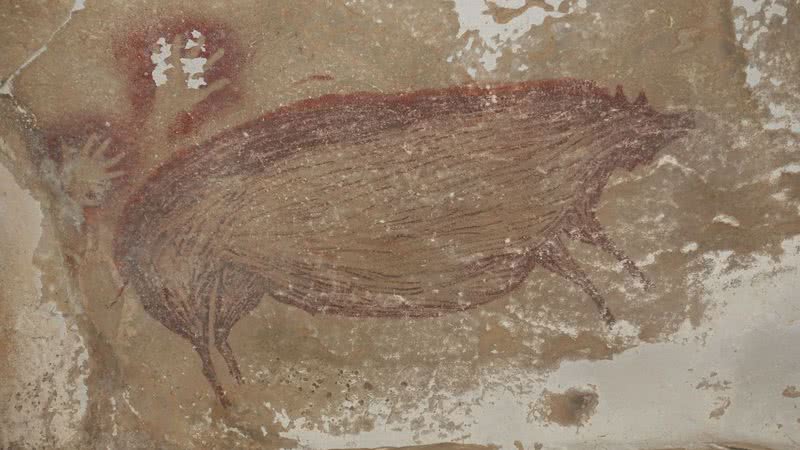
And now we come to the topic that motivated the creation of this content. After all, why would such a specific topic be addressed all of a sudden?
The recent discovery of rock art has turned the eyes of historians around the world to one place: Indonesia.
The painting in question is of a wild boar. The cave art, which was found in the Leang Tedongnge cave on the island of Sulawesi in Indonesia, has just become the oldest work of art ever known to man.
The artwork, believed to depict a wild boar, is 136 centimeters long by 54 centimeters high.
Now you must be wondering: how old is this painting to be considered the oldest in the world?
And the answer comes now. According to an article published in the journal Science, research has shown that the cave art of the wild boar was painted in this cave more than 45,500 years ago!
According to the research results, the wild boar drawn would be of the species Sus celebensis, and was immortalized in the cave with red mineral pigments
This is really fascinating, isn't it?
Is this really the oldest cave art in the world?
Of course, despite being the oldest in the world, it is worth mentioning that it is the oldest to date.
Before this recent discovery, the title of oldest cave art in the world belonged to a painting discovered in 2019.
On that occasion, the discovery consisted of a hunting scene that, according to research, had been immortalized on the wall 43,900 years ago.
Coincidentally, both discoveries were made by the same team. The only difference was the cave.
While the wild boar was discovered in Leang Tedongnge Cave, the hunting scene was discovered in a nearby cave, both on the same island.
At any moment, a new exploration may come across yet another fascinating discovery and, after due studies, discover that this new discovery is even older than the previous one.
Currently, it is estimated that there are more than 400,000 archaeological sites that have rock art around the world.
But, despite these sites already being catalogued, there is nothing to stop there being several others out there that have not yet been discovered by man.
The truth is that history is something that is constantly improving, resulting in new discoveries that allow us to visualize our past and how our ancestors lived more clearly.
Conclusion
It's really fascinating to have any kind of contact with discoveries like this.
Although we all know that there were different periods of humanity before we got to where we are, this type of cave art tells us a lot.
It is through them that we can get a brief glimpse of what our ancestors' lives were like thousands of years ago.
Therefore, it is important that these types of places where these discoveries occur – so-called archaeological sites – are properly preserved.
After all, this is a very significant part of our history and helps us trace a timeline from the beginning of humanity to today.
Did you like this content? Then take the opportunity to read it too Volcanic eruptions: the worst in recent years
