Cities in Brazil that speak another language: Discover the options!
Advertisements
Have you ever imagined finding places in Brazil where Portuguese isn't the primary language? Check out these cities in Brazil that speak another language!
A Linguistic diversity in Brazil It is much larger than the Portuguese one.
In some cities, culture and immigration have left strong marks.
Therefore, it is possible to hear languages such as German, Polish, and Japanese in everyday life.

Key Points
- Saint Gabriel da Cachoeira It is known for its four official languages in addition to Portuguese.
- Marshal Candido Rondon It is home to a large number of speakers of the Hunsrückisch German dialect.
- Prudentópolis is home to a significant Ukrainian community in Paraná.
- Pomerode preserves German culture in Santa Catarina.
- Indigenous communities in Brazil comprise 305 ethnic groups and speak 274 different languages.
Introduction to Linguistic Diversity in Brazil
Brazil is famous for its cultural diversity.
This is very evident in the many languages spoken here.
Since indigenous languages Even with the European impact, linguistic diversity is essential to who we are.

Today, Brazil has approximately 207 million people. And 991,300 of them speak Portuguese.
This is due to many historical, social, and geographical factors over the years.
It's not just Portuguese that's spoken here.
There are also indigenous and immigrant languages, such as German, Italian, Spanish, and Japanese.
In São Paulo, for example, you also hear Arabic, Chinese, Hebrew, among others.
According to the National Inventory of Linguistic Diversity (INDL), there are approximately 250 languages spoken in Brazil.
This includes indigenous languages and Creole women.
In the south and southeast, for example, Brazilian German and Brazilian Venetian are very common.
In 2010, 274 indigenous languages and 305 different ethnic groups were counted.
This shows the richness of traditions and cultures that exist here.
Linguistic variations can be divided into several types:
++ Why is the Taj Mahal considered the greatest testament to love in the world?
| Type of Variation | Description |
|---|---|
| Diatopic | Due to geographical differences between speakers. |
| Diastratic | Influenced by sociocultural differences. |
| Diachronic | Resulting from the passage of time, constantly evolving. |
| Diamesics | Between speech and writing, or between textual genres. |
A European influence It is also very important for the linguistic diversity of Brazil.
German, Italian, and Japanese immigrants brought their languages with them.
This has further increased the country's linguistic diversity.
Linguistic economics, which is sociocognitive, also helps to create new dialects and forms of expression.
The large number of indigenous languages It showcases the rich linguistic diversity of Brazil.
INDL was created to value and protect these languages.
They work to document and preserve these languages, maintaining Brazil as a multilingual and culturally rich country.
Pomerode: A Little Piece of Germany in Santa Catarina
The city of Pomerode, In Santa Catarina, it's a true piece of Germany in Brazil.
Approximately 801% of the population speaks German. This demonstrates the strength of German culture and the traditions that remain alive.
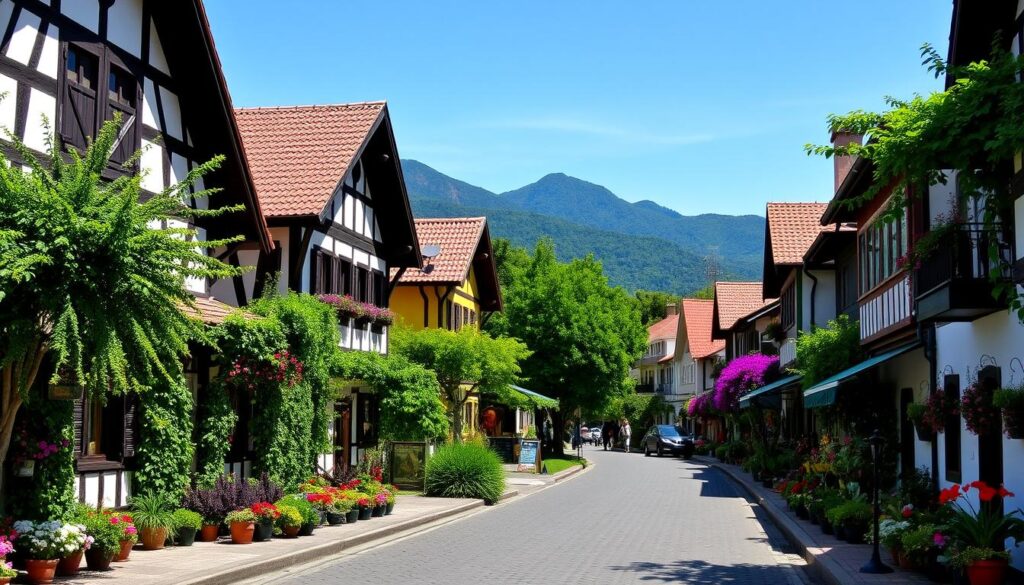
Pomerode is part of the European Valley, along with 14 other cities. This valley is a true cultural and natural treasure.
It is home to a rich diversity of wildlife, such as capybaras and toucans.
O Pomerode Zoo It is the largest in Santa Catarina, with over 1200 animals.
O Enchanted Village Zoo It has over 25 attractions for families. It's a place for entertainment and environmental education.
In Pomerode, there are 220 buildings in the half-timbered style.
This represents the largest complex outside of Germany. Visiting these buildings is to immerse yourself in German history and culture.
The city has many traditional German festivals.
A Osterfest and the Pomeranian Festival They are famous. They celebrate German heritage with music, dance, traditional food, and craft beer.
Pomerode, in the heart of the European Valley, is a haven of Germanic culture.
It's a delightful experience for anyone who wants to explore cultural influence in Brazil.
To explore this region, Freeway offers authentic journeys.
You will have the chance to meet local residents and explore the Atlantic Forest.
You can also find typical souvenirs, such as local handicrafts and cachaça (Brazilian rum).
Visit Pomerode and celebrate the German culture in Brazil. It's a charming piece of Germany in Santa Catarina.
| Attraction | Description |
|---|---|
| Pomerode Zoo | The largest zoo in Santa Catarina, with over 1200 animals. |
| 220 Half-timbered Buildings | Largest architectural complex outside of Germany. |
| Enchanted Village Zoo | More than 25 attractions for families with children. |
| Traditional Festivals | Osterfest and Festa Pomerana celebrate German culture. |
Itaiópolis: Preservation of the Polish Language in Santa Catarina

In Itaiópolis, Santa Catarina, the Polish language is highly valued.
Many Polish immigrants They still speak that language, especially the older generations.
The community works together to keep this linguistic tradition alive.
A study showed that 56% of the descendants of Poles in Paraná speak Polish well.
This shows the importance of keeping the Polish language alive in Itaiópolis.
A study by VARLINFE revealed that in communities with Polish immigrants In Paraná, bilingualism is common.
Although Portuguese is gaining ground, the effort to maintain Polish is ongoing.
In 1914, Santa Catarina had 9 Polish schools, including Itaiópolis.
These schools educated 180 students. After nationalization in 1937, the number of schools decreased, but Polish culture is still valued.
Today, the community of Itaiópolis works to keep Polish culture alive.
The city's language policies are important for the community's identity.
The members involved in language preservation projects are essential for future generations to learn the language.
++ What is Family Constellation Therapy and what are its benefits?
Santa Maria de Jetibá: German Community in Espírito Santo
Santa Maria de Jetibá, In Espírito Santo, it is an example of cultural preservation.
It has approximately 35,000 inhabitants, 901 of whom are bilingual, speaking Pomeranian and Portuguese.

The city's history is linked to Pomeranian traditions.
The Pomeranian language, though threatened, survived and thrived in Santa Maria de Jetibá. Today, it is taught in the early grades of elementary school.
The residents keep many cultural traditions alive.
Wedding attire is black, unlike in the rest of Brazil.
They also have traditions like sweet peach soup and Christmas poems.
The local economy is based on agriculture.
They are major egg producers and have many coffee plantations. Pomeranian culture is essential to daily life.
| Aspect | Description |
|---|---|
| Population | 35,000 inhabitants |
| Language | Pomeranian and Portuguese |
| Economy | Agriculture (coffee and egg production) |
| Traditions | Black wedding dresses, sweet peach soup, Christmas poems |
Proepo values the Pomeranian language in Santa Maria de Jetibá.
This program strengthened the identity and pride of the residents.
Santa Maria de Jetibá It is an important cultural center. Its architecture, cuisine, and sense of community are unique.
The city celebrates Pomeranian traditions.
São Gabriel da Cachoeira: Linguistic Diversity in the Amazon
Saint Gabriel da Cachoeira It is located 852 kilometers from Manaus.
It has approximately 46,000 people, of which 951 are indigenous.
This place is a symbol of diversity, where various Indigenous languages in Brazil They are spoken.
This shows the respect and value given to indigenous culture.

There, languages such as Nheengatu, Baniwa, and Tukano are very important. Nheengatu It was officially recognized in 2006. It is spoken by the Baré, Baniwa, and Warekena peoples.
Saint Gabriel da Cachoeira It's a unique place in Brazil.
It has four official languages besides Portuguese: Baniwa, Tukano, Nheengatú, and Yanomami.
This demonstrates a unique commitment to language preservation.
| Statistic | Value |
|---|---|
| Total Population | 46,303 inhabitants |
| Proportion of Indigenous People | 95% |
| Urban Population | 11 thousand indigenous people (58%) |
| Indigenous Ethnic Groups | 32 ethnic groups |
| Official Indigenous Languages | Baniwa, Tukano, Nheengatu, Yanomami |
Saint Gabriel da Cachoeira has a strong policy to save the indigenous languages.
It's an example for all of Brazil.
Linguistic diversity, led by indigenous peoples, combats historical silencing.
She keeps alive the traditions and forms of communication of each ethnic group.
Bastos: The Japanese Influence in the Interior of São Paulo
The city of Bastos, São Paulo, clearly demonstrates how... Japanese culture in Brazil It spread.
Since World War II, Japanese families have come here. They brought culture and economics that still have an influence today.
In the 1940s, approximately 200,000 Japanese people and their descendants lived in Brazil.
Many were in São Paulo, Paraná, and Pará. They faced challenges, such as learning Portuguese and changing their eating habits.
But they adapted and helped to diversify the local culture and economy.
The Japanese brought new foods to Brazil.
They introduced soybeans, short-grain rice, azuki beans, and other fruits.
In São Paulo's agribusiness sector, they excelled in the cultivation of peaches and strawberries.
Bastos became a cultural and economic center thanks to immigrants.
Sericulture, for example, brought development in the 1950s and 60s.
Hideo Okawara, an immigrant, worked and studied, traveling 14 km daily to school.
A Japanese culture in Brazil It is also seen in martial arts.
Judo, for example, has 2 million practitioners.
Community festivities and events keep Japanese traditions alive.
In Bastos, São Paulo, these traditions are celebrated in festivals and events.
To better understand Japanese influence, see the table below.
It showcases the contributions and common practices of Japanese immigrants in the region:
| Contribution | Details |
|---|---|
| Introduced Foods | Soybeans, short-grain rice, azuki beans, beets, turnips, radishes, among others. |
| Agricultural Practices | Planting of peach, strawberry, Fuji apple and persimmon trees. |
| Sports | Judo, Brazilian Jiu-Jitsu, and Karate, with a total of 3 million practitioners. |
| Traditional Structures | Tea houses and black tea factories, such as those in Registro (SP) |
Thus, the Japanese culture in Brazil And, especially in Bastos, São Paulo, it is essential.
It offers a unique experience, blending the best of both worlds.
Cities in Brazil that speak another language: Prudentópolis, Ukrainian Culture in Paraná
Prudentópolis is known as the "most Ukrainian city in Brazil". Founded in 1895, the city received many Ukrainian immigrants.
Between 1896 and 1897, approximately 1,500 families arrived, totaling 6,000 people.
Over time, Ukrainian culture has enriched Prudentópolis.
Today, approximately 701% of the population speaks Ukrainian.
Of the 52,000 inhabitants, 39,000 are of Ukrainian descent, representing 75% of the population.
Prudentópolis has more than 100 churches, 50 of which follow the Ukrainian Byzantine rite.
That is why the city is called the "Capital of Prayer." This religious connection strengthens the city's cultural identity.
The first Ukrainian immigrants arrived in 1894-1895.
Since then, the community has maintained its traditions. They celebrate with dances, music, embroidery, and traditional food.
Folkloric groups in Prudentópolis and other cities in Paraná help to preserve these traditions.
Ukrainian heritage is so important that Ukrainian is recognized as the city's second official language.
| Cultural Aspect | Details |
|---|---|
| Language | Approximately 701% of the population speaks Ukrainian. |
| Religion | At least 50 Ukrainian Byzantine rite churches. |
| Population | 39,000 descendants of Ukrainians among the 52,000 inhabitants. |
| Traditions | Ukrainian dances, music, embroidery, and cuisine. |
Prudentópolis, Paraná She highly values her Ukrainian heritage.
This culture is part of daily life, ensuring that new generations continue to celebrate this rich culture.
++ Discover how music influences our mood.
Marshal Candido Rondon: German Dialect in Paraná
Marshal Candido Rondon, The state of Paraná is famous for its German immigration.
The city preserves the Hunsrückisch dialect, spoken by the elderly and taught to the young.
Other Brazilian cities also have a rich linguistic diversity.
In Santa Catarina, Antônio Carlos preserves the Pomeranian dialect.
In Paraná, Japurá is known for its Japanese community, where Japanese is spoken.
This diversity demonstrates the cultural and linguistic influence in Brazil.
From German and Pomeranian dialects to indigenous languages in the Amazon and languages such as Japanese, Arabic, and Italian in São Paulo.
| City | Common Language/Dialect | Features |
|---|---|---|
| Marshal Candido Rondon | Hunsrückisch | Cultural preservation by descendants of Germans |
| Antonio Carlos | Pomeranian | A community of just over 7,000 inhabitants, with traditions passed down from generation to generation. |
| Japurá | Japanese | Influence of Japanese immigrants on local culture |
| São Paulo | Japanese, Arabic, Italian | Neighborhoods with a strong presence of immigrant communities. |
| Amazon | Various Indigenous Languages | Impressive linguistic variety |
Marshal Cândido Rondon is a key point for anyone interested in German immigration.
The city demonstrates how the traditions and languages of immigrants are kept alive for generations.
Cities in Brazil that speak another language: Barra do Corda, Portuguese and Tupi in Maranhão
Barra do Corda is located in Maranhão and showcases the mix of native languages in Brazil.
It has 84,532 inhabitants and covers 5,187.673 km². It is the 12th largest city in the state by area.
The Guajajara people are very present in the region.
They coexist with Portuguese and Tupi. This demonstrates the linguistic diversity of the city.
The 2022 IBGE Census counted 57,214 indigenous people in Maranhão. 72,931 of them live on indigenous lands.
The Guajajara, speakers of Tupi-Guarani, are located in more than 10 Indigenous Territories in Maranhão.
Barra do Corda is famous for its indigenous culture and cultural events.
Carnivals and June festivities attract tourists from all over Brazil. In 2021, the city's GDP was R$ 889,327, the 20th largest in Maranhão.
The population is diverse: 63% are mixed-race, 23.2% are white, 7.4% are black, and 6.3% are indigenous.
Tupi is still spoken in several communities. This shows the city's rich cultural heritage.
Since 1835, Barra do Corda has been a meeting point of cultures. The mixture of Portuguese and Tupi demonstrates the city's cultural fusion.
Nova Petrópolis: A German Experience in Rio Grande do Sul
Located in the heart of the Serra Gaúcha, New Petrópolis preserves German culture in Rio Grande do Sul With love.
Its population of 20,000 inhabitants in 300km² makes it a piece of Germany in Brazil.
Germanic influence is visible throughout. New Petrópolis.
Over 60 community choirs fill the city with music.
Furthermore, 70% of the population speaks Hunsrück, a language brought by German immigrants in the 19th century.
The city's cuisine is rich and varied.
With over 40 establishments, you can find everything from German cuisine to artisanal pizzas.
Highlights include Colina Verde and Mukli Alfajores, famous for their dishes.
Tourists love the natural and architectural beauty of New Petrópolis.
Republic Square, or Flower Square, is a must-see. With one hectare of green space, it's a perfect location for events.
| Attraction | Description | Time | Price |
|---|---|---|---|
| Flower Square | Green area with beautiful flowers | 24h | Free |
| Immigrant Village Park | Recreation of the environment of the German colonists. | 8:00 AM – 5:30 PM | R$ 10 |
| Sculpture Park Stones of Silence | Over 80 sculptures depicting the history of German immigration. | 9:30 AM – 6:00 PM (Thu-Sun) | R$ 30 (guided tour) |
Nova Petrópolis is the Garden of the Serra Gaúcha, attracting 200,000 tourists annually.
Its hotel network offers more than 2,000 beds, ensuring comfort for everyone.
Come and discover Nova Petrópolis. Experience its charm, gastronomy, and... German culture in Rio Grande do Sul In an authentic and unforgettable way!
Bento Gonçalves: The Italian Influence in the Serra Gaúcha
Bento Gonçalves, in Rio Grande do Sul, shows the influence of Italian immigrants in Brazil.
It's a city that immerses itself in Italian culture. This includes the food and the language.
For example, 90% of the population speaks the Talian dialect as a co-official language since 2015.
One of the biggest attractions is the steam train through the Serra Gaúcha region.
It allows visitors to experience the history of Italian immigrants.
While exploring vineyards and traditional cuisine, one can commonly see Italians on the streets, showcasing the cultural influence.
In Nova Petrópolis, Rio Grande do Sul, 70% speaks Hunsrückisch, preserving Germanic culture.
But Bento Gonçalves It stands out for its Italian culture. This is evident in the language and traditions that are still alive today.
| Features | Bento Gonçalves | New Petrópolis |
|---|---|---|
| Co-official Language | Talian (Italian) | Hunsrückisch (German) |
| % of the Population that Speaks the Dialect | 90% | 70% |
| Tourist Attractions | Steam train, Vineyards | Squares, German Architecture |
Visiting these cities is to explore the cultures of Italian immigrants in Brazil and Germans.
They enrich the country's cultural heritage with their unique languages, traditions, and flavors.
++ The Mystery of the Nazca Lines: Ancient Art or Extraterrestrial Messages?
Cities in Brazil that speak another language
Brazil is a country with many languages and cultures. In several cities, linguistic and cultural traditions are still alive.
Let's look at some of these cities and how... Language and culture in Brazil They express themselves in them.
Pomerode (SC): This city is a piece of Germany in Santa Catarina.
German is spoken as a native language, showcasing a rich culture.
Santa Maria de Jetibá (ES): In Espírito Santo, the Pomeranian culture is still strong.
It is an important point for the language and culture of the region.
Bento Gonçalves (RS): In the Serra Gaúcha region, the Italian influence is significant.
The Italian language is widely used in food and other cultures.
Nova Petrópolis (RS): Here, German and German traditions are very important.
They connect generations and are essential to the city's identity.
Barra do Corda (MA): Here, Portuguese and Tupi languages are mixed.
This demonstrates the linguistic diversity of the region.
São Gabriel da Cachoeira (AM): With many indigenous ethnic groups, the city has a great linguistic diversity.
More than 23 ethnic groups, including Nheengatu, Baniwa, Tukano, and Yanomami, live there. Approximately 801% of the population is indigenous.
| Cities | Languages Spoken | Cultural Highlights |
|---|---|---|
| Pomerode (SC) | German | German culture, festivals, gastronomy |
| Santa Maria de Jetibá (ES) | Pomeranian | Pomeranian traditions, architecture |
| Bento Gonçalves (RS) | Italian | Wines, Italian cuisine |
| New Petrópolis (RS) | German | Germanic traditions, gardens |
| Barra do Corda (MA) | Portuguese, Tupi | Indigenous culture, local artifacts |
| São Gabriel da Cachoeira (AM) | Nheengatu, Baniwa, Tukano, Yanomami | Cultural preservation, indigenous crafts |
A Language and culture in Brazil They make the experience of living in or visiting these cities very enriching. Preserving these languages keeps the traditions alive.
They also strengthen relationships between people and cultures.
Cities in Brazil that speak another language: Conclusion
Exploring Brazilian cities with languages other than Portuguese reveals the country's rich culture.
Brazil has around 250 languages, including indigenous and immigrant languages.
Each city is an important piece in this linguistic mosaic, demonstrating the importance of preserving these heritages.
In São Gabriel da Cachoeira, for example, we speak Portuguese, Nheengatu, Tucano, and Baniwa.
In Espírito Santo, Pomeranian is spoken. Brazil also has many Spanish speakers, thanks to tourism and economic relations.
Valuing linguistics is crucial to strengthening Brazil's cultural identity.
This helps to build a diverse and welcoming nation.
By celebrating this diversity, we recognize the richness that each community brings to Brazil.