How science studies hidden oceans on icy moons.

Advertisements
The search for life beyond Earth has entered a new chapter in the outer reaches of the Solar System. Currently, the Science studies hidden oceans on icy moons. through advanced astrobiology and robotic space probes.
Distant worlds, previously seen only as frozen and barren spheres, are revealed to be dynamic environments with masses of liquid water underground far exceeding the combined volumes of Earth's oceans.
This article explores the scientific methodologies, recent space missions, and astrobiological implications of these fascinating discoveries. Prepare to delve into the mysteries hidden beneath kilometers of cosmic ice.
Executive Summary
- The concept of habitable zones on the moons of gas giants.
- Technological tools used in the detection of subsurface liquid water.
- The importance of the Europa Clipper mission and consolidated data on astrobiology.
- Frequently asked questions about the habitability of these distant ocean worlds.
What are ocean worlds in the Solar System?
The old idea of a habitable zone — that ideal range where the distance from a star allows for liquid water on the surface — has fallen by the wayside. The concept has become outdated.
Astrophysicists have realized that the true heat engine of these distant worlds does not come from the Sun, but from the gravitational tug-of-war that generates heat through tidal forces.
Europa, the enigmatic moon of Jupiter, and Enceladus, the active jewel of Saturn, are the most striking examples that biology doesn't need open skies to exist.
Spectroscopic data shows that these dark abysses conceal saltwater, geothermal heat, and organic compounds. A perfectly chemical environment is silently occurring beneath the frozen crust.
How does science study hidden oceans on icy moons in practice?
Forget about drills and direct drilling, as we're talking about impenetrable layers of ice. Scientists rely on magnetometers to read invisible magnetic disturbances caused by moving saltwater.
Ice-penetrating radar also comes into play, firing electromagnetic waves that pinpoint the exact boundary where solid ice gives way to deep liquid ocean.
Mass spectrometry does the rest of the heavy lifting, analyzing the icy smoke spewed by cryovolcanoes and hydrothermal plumes without any probes needing to land.
Computer models of geodynamics align these orbital readings, simulating how the constant gravitational stress of giant planets deforms the internal structure of these icy moons.
+ Why the Human Brain Hates Change, According to Modern Neuroscience
Which space missions are leading current astrobiological exploration?
NASA and the European Space Agency (ESA) are locked in a silent scientific race, sending their best robotic eyes to the far reaches of the outer Solar System.
The Europa Clipper probe performs close, surgical flybys, collecting crucial data to determine whether Jupiter's moon truly has the conditions to harbor complex organic chemistry.
Meanwhile, ESA's JUICE mission focuses its attention on the Jupiter system, investigating the hidden dynamics of Ganymede and the mysterious Callisto.
This telemetry data serves as the basis for what comes next: the conceptual development of autonomous underwater robots designed to withstand brutal pressures.
The table below summarizes the main physical characteristics and targets of these detailed scientific investigations in the most extreme environments of our planetary system:
| Icy Moon | Host Planet | Estimated Thickness of the Ice Crust | Estimated Depth of the Hidden Ocean | Main Scientific Mission |
| Europe | Jupiter | 15 to 25 kilometers | 60 to 150 kilometers | Europa Clipper (NASA) |
| Enceladus | Saturn | 5 to 10 kilometers (at the South Pole) | 30 to 40 kilometers | Orbilander (Proposed concept) |
| Ganymede | Jupiter | 100 to 150 kilometers | Approximately 100 kilometers | JUICE (ESA) |
Why is thermal and chemical energy vital in these ecosystems?
Without sunlight, photosynthesis is impossible. Life in these abysses depends entirely on chemosynthesis, a more rudimentary and primitive process fueled by the planet's own interior.
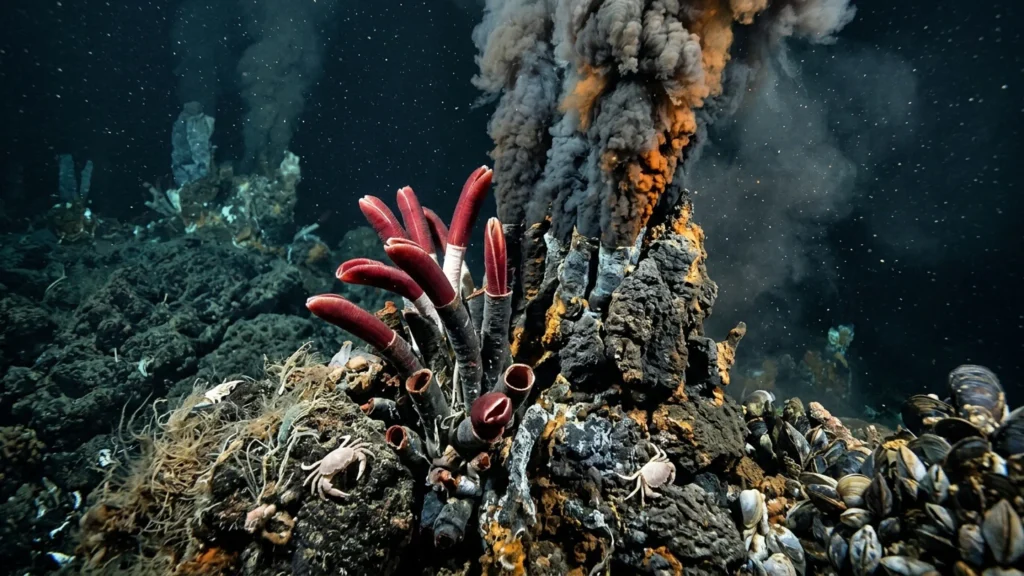
Hydrothermal vents in the rocky depths of these moons release minerals and molecular hydrogen, a scenario identical to what we see in the abyssal trenches of Earth's oceans.
This direct interaction between the heated rock and the saltwater generates gradients of chemical energy. It is the perfect fuel to sustain cellular metabolisms isolated from the rest of the universe.
Scientists are using Earth's extremophiles as a biological mirror to try to predict the behavior of microorganisms that thrive under overwhelming pressure and eternal darkness.
Detailed studies published on the astrobiology portal of NASA Science They demonstrate how these ecosystems depend exclusively on underwater volcanism to maintain their long-term thermal and chemical stability.
What are the biggest technological challenges faced by scientists?

The immense physical distance requires the probes to operate with nearly independent artificial intelligence. The delay in commands from Earth makes real-time control impossible.
Furthermore, Jupiter's magnetic field acts as a natural particle accelerator, bombarding the electronic circuits of spacecraft with harsh radiation on each orbit.
Another critical point is planetary protection: the instruments need absolute sterilization so that we don't carry over terrestrial microbes that could spoil future alien samples.
Finally, creating batteries and heating systems that last for decades in the extreme cold of deep space challenges the current limits of materials engineering.
+ The scientific mystery surrounding hidden oceans on distant moons.
How do terrestrial analogues help in understanding these worlds?
Researchers isolate themselves in places like Lake Vostok in Antarctica, testing sterile drilling techniques in subglacial lakes that have been locked by ice for millions of years.
The behavior of bacteria that thrive in volcanic vents in the Atlantic Ocean helps to calibrate our expectations about what defines the true limits of life.
These extreme natural laboratories help fine-tune optical and chemical sensors before they are launched into space on missions with no recall option.
This reverse engineering dismantles the prejudice that life needs a blue sky to thrive, opening space for a much more resilient biology.
Mapping these geochemical signatures on Earth makes it easier to identify gaseous bioindicators when orbital sensors analyze the vapor jets ejected into space by moons.
+ What science already knows about the possible Planet Nine.
Conclusion
The investigation of these invisible oceans shifts the focus of our search for answers in the cosmos, proving that liquid water is far more common than we imagined.
As the Science studies hidden oceans on icy moons., The idea of a strictly terrestrial biology loses strength in the face of geological evidence from the Solar System.
Advances in aerospace technology and missions planned for the coming years may finally transform theoretical assumptions into one of the greatest milestones in human history.
To keep up with official technical reports and real-time updates on robotic discoveries in deep space, consult the specialized repository of [website name]. European Space Agency.
Frequently Asked Questions (FAQ)
Is there liquid water on the surface of icy moons?
No. The extremely low surface temperature combined with the absence of a real atmosphere causes any exposed water to freeze instantly or evaporate immediately.
How does water remain liquid under thick ice?
The secret lies in tidal heating. The overwhelming gravity of giant planets deforms the core of moons, generating internal friction and constant heat.
Will the Europa Clipper probe land on the surface of Europa?
No. The mission strategy involves multiple low-flying, fast flights to collect orbital data, avoiding premature degradation from Jupiter's heavy radiation.
What are the plumes observed on Enceladus and Europa?
These are large, textured jets of water vapor, organic compounds, and salts, expelled through fractures in the frozen crust due to internal hydrothermal pressure.
Has life already been found on these icy moons of the Solar System?
So far, no direct biological evidence has been detected. What scientists do know is that the ideal chemical conditions for life are all there.