
What does the carnivorous plant eat and where can you find it?
Advertisements
Today is the day to explore a little more about what carnivorous plants eat and what the main characteristics of this type of plant are!
Everyone knows that one word that can be used to define the flora and fauna of our planet is diversity!
Thanks to all the particularities of each country and region, our planet is extremely rich when it comes to the species of animals and plants that exist there.
And it is precisely one of these points that we will explore a little more throughout today’s text.
We are talking about the famous carnivorous plants.
Who has seen any of these plants in films or series and was curious to know more about how these curious plants work?
Throughout today's content, we will explore these curious and mysterious plant species together.
Here you will discover what carnivorous plants eat, which are the main species known to humans and where you can find them.
What is a carnivorous plant?
Everyone who has ever come across a carnivorous plant has been at least a little curious to better understand how this curious plant – which is different from other plants we are used to seeing – works.
Carnivorous plants – which are also known as insectivorous plants – are plants that have the incredible ability to attract small animals to capture, digest and use the nutrients of these prey for themselves.
For this capture to occur, most of these plants have some type of traps made up of their modified leaves, which serve to attract their prey.
When it comes to digestion, it can be said that it is very similar to what we are used to.
This is because, to properly digest their prey, these species of carnivorous plants use digestive enzymes specifically designed for this purpose.
And, just like all of us and other animal species – who use the nutrients obtained through our diet to obtain energy and nutrients – carnivorous plants use the nutrients from their prey – mainly hydrogenated compounds – to survive.
In general, this is the feeding cycle that most carnivorous plant species follow.
To date, it is estimated that there are around 600 species of carnivorous plants in the world. But that doesn't mean there aren't many other species out there that have yet to be discovered by humans.
What does the carnivorous plant eat?
After understanding a little more about how the famous carnivorous plants work, it's time to talk about the diet of these peculiar plants.
Of course, the diet of each species can vary due to its size or habits.
But in general, the diet of these carnivorous plants usually includes insects – which are the main prey of carnivorous plants – and arachnids.
Larger species can even capture amphibians, reptiles and some species of birds.
In other words: for those who think that carnivorous plants only eat small insects like flies and spiders, it's best to rethink that idea.
What are the main types of capture systems used by carnivorous plants?
Remember what we mentioned in the first topic about the traps and tactics used by carnivorous plants?
These techniques are, in general, the main way to identify plant species. And they can be easily divided into three types: sticky leaves, cage and suction.
Check out a little more about each of these types of carnivorous plants:
Carnivorous plants with sticky leaves
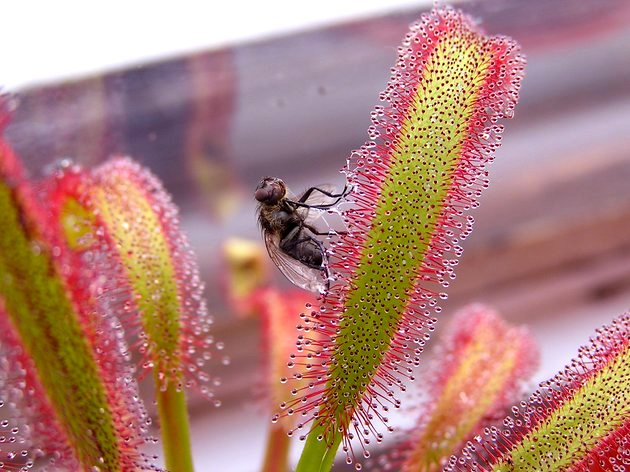
As the name suggests, these plants have substances spread throughout their leaves.
These substances are essential for attracting unsuspecting insects that, upon landing, end up getting trapped and thus serve as food for the plant.
Cage-type carnivorous plants
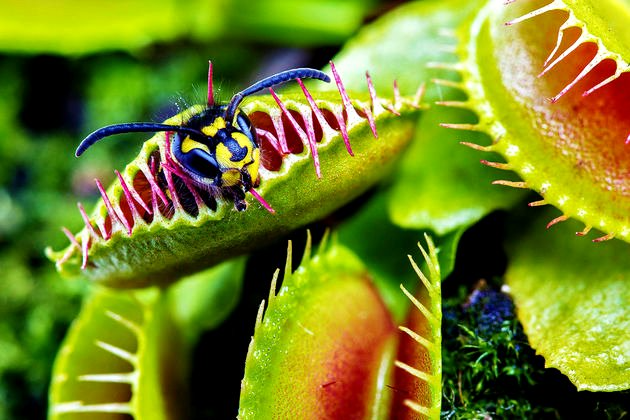
The second type of carnivorous plants on our list are cage plants.
This type – which is perhaps the most popular type of carnivorous plant when talking about these plant species – usually has two halves, with bristles located on the edges.
These bristles – upon detecting the presence of prey – close, sealing the fate of the unsuspecting insect forever.
Suction-type carnivorous plants

The third and final type of carnivorous plant on our list is the suction type.
These plants – which are also known as pitcher plants, due to their shape – also have a very simple capture system:
In this case, when the presence of prey is felt near the opening that serves as the entrance to the plant, the animal in question ends up being sucked into this channel, thus victimizing yet another poor insect.
Despite being types of carnivorous plants with different capture systems, most of them have one factor in common that increases the chances of capturing their prey: their colors.
Most of these plants have strong, vibrant colors, serving as an attraction for the prey of these carnivorous plants.
Take the opportunity to read it too 👉 What plants like sun? Discover 7 species!
Where to find carnivorous plants?
Unlike what one might imagine when seeing a carnivorous plant, the natural habitats of these species are usually places where there is 'poor' and waterlogged soil, such as marshes and territories close to these areas.
That said, it is also important to note that most carnivorous plants are relatively small, usually not exceeding 15 cm in height.
And taking into account the presence of carnivorous tips around the world, there are some curious facts that are worth mentioning.
Starting with the incidence of carnivorous plants. Despite appearing exotic, these plants are present practically all over the world.
In the entire world, the only place where there are no records of carnivorous plant species is Antarctica.
On the other hand, Brazil stands out when it comes to carnivorous plants.
Our country is considered the second country with the most varieties of carnivorous plant species. We are only behind Australia on this list.
Did you like today's content? Then take the opportunity to read it too Plants that attract positive energy: 5 options to grow at home
