Giant fungus discovered in China has a lineage dating back 65 million years.
One Giant fungus discovered in China It revealed to scientists an evolutionary lineage that survived the extinction of the dinosaurs about 65 million years ago.
Advertisements
The scene took place in the humid forests of Yunnan, a corner of the world where nature seems to work at its own pace.
Researchers at the Kunming Institute of Botany noted that the specimen belongs to the genus Fomitiporia, with disproportionate size and remarkably preserved genetics.
There is something unsettling about this persistence: while empires, continents, and entire species have disappeared, this organism has maintained the same biological blueprint.
This is often misinterpreted as mere geological luck, when in fact it involves fine resilience and constant adaptation.
Next, we examine what this finding says about the biology, geography, and tenacity of life.
Article Summary:
- What is the species of giant fungus found in Chinese forests?
- Where exactly did scientists locate this ancient organism?
- How did the researchers prove the evolutionary age of 65 million years?
- What are the actual dimensions and physical characteristics of the specimen?
- Who led the scientific expedition and published the official results?
- Why did this lineage survive the Cretaceous extinction?
- Comparative table: The Yunnan giant versus other colossal fungi
- Conclusion
- Frequently Asked Questions (FAQ)
What is the species of giant fungus found in Chinese forests?
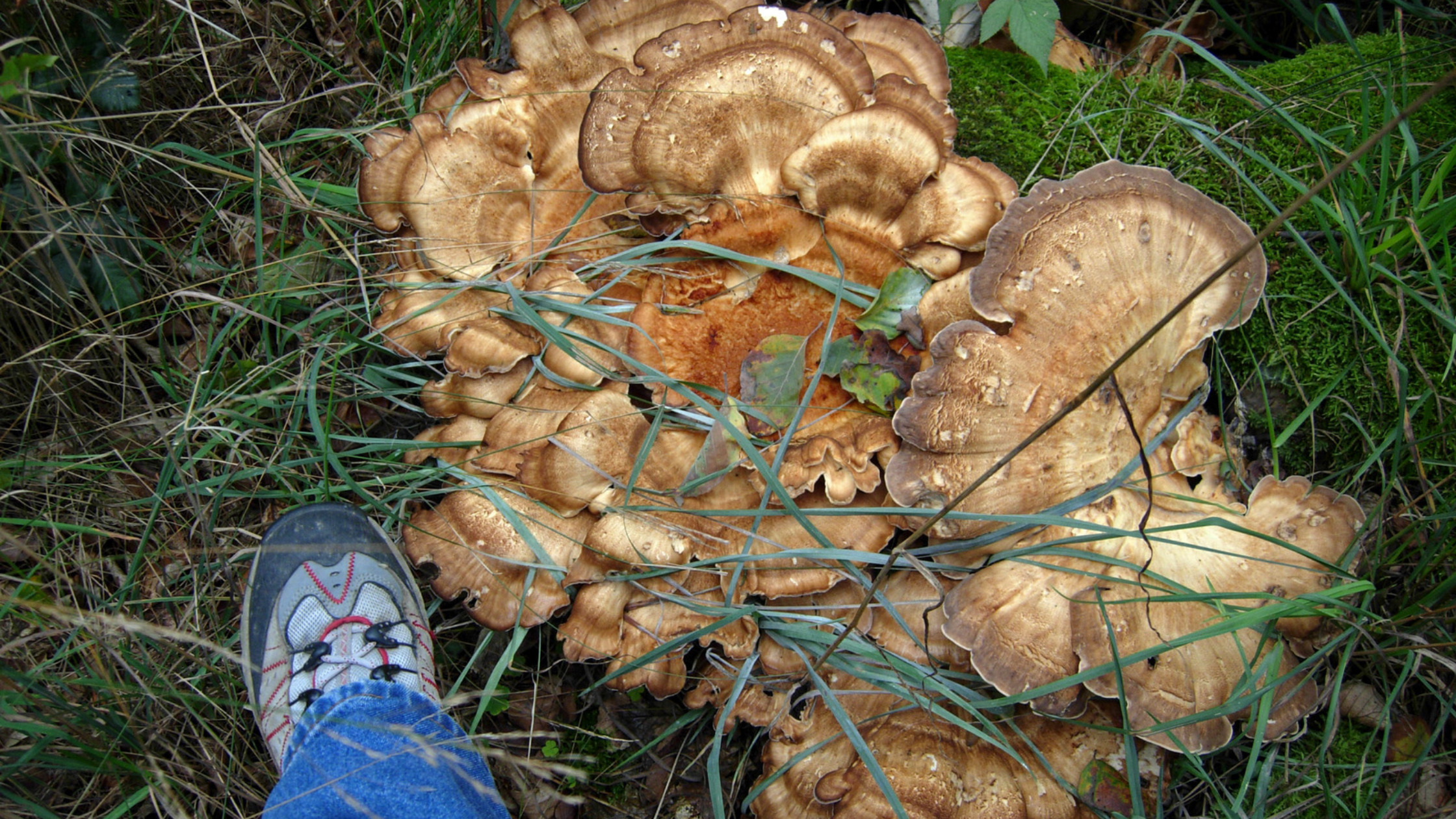
The specimen cataloged by mycologists belongs to the family Hymenochaetaceae, within the complex of the genre Fomitiporia, near Fomitiporia ellipsoidea.
Polypores of this type build hard, persistent fruiting bodies on fallen trunks, almost like sculptures of living wood.
Unlike transient mushrooms that sprout after a heavy rain and disappear in two days, the Giant fungus discovered in China It advances slowly for decades.
Its hyphae penetrate deep into dead wood and release enzymes that break down cellulose and lignin without apparent haste.
In practice, it acts as a tireless cleaner of subtropical forests. Without this silent recycling work, trunks and branches would pile up, suffocating the soil and hindering the forest's regeneration.
Where exactly did scientists locate this ancient organism?
The team found the structure in Yunnan province, in southwestern China, near the borders with Myanmar and Laos.
The rugged terrain and varied microclimates have transformed the area into a natural refuge for species that have been left behind elsewhere.
In the Xishuangbanna reserves, the organism grew beneath a large tree trunk. Cyclobalanopsis, an oak tree native to the region.
The constant humidity and muggy air under the tree canopy kept the environment stable enough for this continuous growth.
During the Pleistocene, severe glaciers swept across much of the Northern Hemisphere, but the mountains of Yunnan escaped the worst. Therefore, the area holds veritable living fossils, survivors of ancient maps that no longer exist.
How did the researchers prove the evolutionary age of 65 million years?
To estimate the depth of this history, the team turned to phylogenomics and molecular clock models calibrated by fossils.
They extracted ribosomal DNA and sequenced genomic sections of the giant fungus discovered in China to compare it with closely related species.
Analyses indicated that the divergence of this lineage occurred around the transition between the Cretaceous and the Paleogene.
This coincides precisely with the time of the Chicxulub impact, the collision that ended the reign of non-avian dinosaurs 65 million years ago.
According to records from Fungal Diversity by Springer Nature, The genetic stability of this group is noteworthy for its consistency.
The enzymes involved in lignin degradation survived throughout the Cenozoic era without losing their central function.
What are the actual dimensions and physical characteristics of the specimen?
The fruiting body measured in the field reached 10.85 meters in length, approximately 82 centimeters in width, and five centimeters in thickness.
Weighing nearly 500 kilograms, it surpassed any fungal reproductive structure ever recorded with such clarity by science.
On the outside, it displays brownish and grayish tones, a firm texture reminiscent of pressed cork, and a multitude of tiny pores on the underside.
Based on estimates of the density of these pores, a single individual can release trillions of spores into the air throughout the year.
The inner layers show that the specimen examined had accumulated at least twenty years of continuous activity. Each growth band preserves a small extract of the climate that prevailed in that forest.
Who led the scientific expedition and published the official results?
The work was led by mycologist Yu-Cheng Dai of Beijing Forestry University, in collaboration with researchers from the Chinese Academy of Sciences.
It took more than ten years of systematic searching and collecting in southwest Asia until the definitive record was obtained.
In the beginning, the Giant fungus discovered in China It could easily pass for old wood covered in moss. Only close examination, with a magnifying glass and tissue collection, made it clear that everything there was part of a single continuous body.
The collected material was stored in the herbarium of the Beijing Institute of Microbiology for consultation and verification. Making the specimen accessible avoids guesswork and allows other laboratories to test the same evidence.
++ What Science Already Knows About Life in Extreme Environments
Why did this lineage survive the Cretaceous extinction?
The explanation lies in their saprophytic lifestyle, which does not require direct sunlight to obtain energy.
When the dust and ash from the impact reduced photosynthesis and destroyed vegetation on a large scale, there was no shortage of dead wood.
With so much organic matter falling to the ground, fungi adapted to decomposing woody fibers found abundance where much life dwindled.
The catastrophic scenario for green plants has paradoxically turned into a prolonged feast for resilient decomposers.
Phenolic compounds in the perennial structure also helped retain moisture and ward off hungry insects. This chemical protection explains why the lineage remains strong in Asian forests without needing radical reinventions.
++ Lava planet reflects up to 75% of light and intrigues astronomers in space.
Comparative table: The Yunnan giant versus other colossal fungi
The table gathers real data to compare the sample of Fomitiporia ellipsoidea found in China, among other famous cases in mycology:
| Biological Characteristic | Fomitiporia ellipsoidea (China) | Armillaria ostoyae (USA) | Ritidoporus ulmarius (United Kingdom) |
| Main Location | Yunnan Province, China | Malheur National Forest, Oregon | Kew Botanic Gardens, London |
| Record-breaking structure | Visible fruiting body | Underground mycelial network | Basal fruiting body |
| Maximum Dimension | 10.85 meters long | 9.65 square kilometers | 1.70 meters in diameter |
| Estimated Mass | Approximately 500 kg | Between 7,500 and 35,000 tons | Approximately 300 kg |
| Lineage Age | Approximately 65 million years | Pleistocene lineage | Tertiary lineage |
| Nutrition Mode | Deadwood saprophyte | Root parasite and saprophyte | Saprophyte of old trees |
Comparing these cases helps to separate magnitudes that are often mixed up in quick conversations.
THE Armillaria ostoyae It dominates a gigantic underground area, while the Chinese find boasts the largest exposed fruiting body ever documented.
++ Ancient 2,700-year-old eclipse reveals changes in Earth's rotation.
Impact of the discovery on biotechnology and environmental conservation.

Investigate the Giant fungus discovered in China It is also of interest to those seeking less aggressive industrial processes.
Oxidative enzymes capable of breaking down resistant plant polymers could reduce the cost of biomass conversion routes without relying on heavy reagents.
In the production of second-generation biofuels and in the research of bioactive molecules, this enzymatic repertoire is attracting practical attention.
However, none of this flourishes if the original habitat is destroyed by deforestation or drastically altered by climate change.
Preserving ancient forests in Yunnan is to uphold a genetic archive shaped over tens of millions of years.
To keep up with global guidelines and assessments on threatened biodiversity, it is worth consulting the International Union for Conservation of Nature (IUCN).
Conclusion
THE Giant fungus discovered in China It forces us to look at Earth's history with less haste and less human vanity.
Greatness doesn't always come with a roar or monumental stature; sometimes it hides beneath a fallen tree trunk, working silently.
If the forest continues to lose ground, we lose along with it biological solutions that took geological eras to mature. Perhaps the greatest merit of this finding is that it reminds us that the continuity of life depends on discreet networks that almost no one notices.
Frequently Asked Questions (FAQ)
1. Is the giant fungus discovered in China poisonous or edible for humans?
It is not suitable for culinary use because it has a hard, fibrous consistency, similar to dry wood.
Although it does not have the toxic reputation of species such as those of the genus Amanita, Chewing and digesting something so rigid would be impractical in practice.
2. How can a fungus live and grow for tens of millions of years?
The visible body is a few decades old, but the genetic lineage spans approximately 65 million years.
The succession of generations via spores has kept this biological heritage active through different eras.
3. What is the difference between the giant Chinese fungus and the giant Oregon fungus?
The Yunnan specimen has the largest visible fruiting body on the wood, exceeding ten meters in length.
Already the Armillaria ostoyae Oregon's forest forms an extensive mycelial network hidden beneath the forest floor.
4. Is the giant Yunnan specimen still alive in the forest today?
Fruiting bodies have a limited life cycle and eventually degrade as the host tree succumbs to the effects of time.
Even so, the species' population and its genetic diversity remain protected in Yunnan's reserves.
5. Why did it take scientists so long to discover a fungus that is almost 11 meters long?
The brown color and rough surface are easily mistaken for the worn bark of fallen tree trunks.
Since it's usually located on the underside of the wood, it escapes the hurried gaze of those passing by on the trail.