The Mystery of Human Footprints Found in Unlikely Places
Advertisements
The enigma of human footprints found in unlikely places It challenges the pride of archaeologists and scientists around the world, forcing us to tear out entire chapters from textbooks on human evolution.
These records from arid deserts, massive rocks, and isolated islands generate fierce debates that divide the academic community.
Deciphering these markings requires cutting-edge technology and, above all, a detachment from old historical dogmas.
In this article, we will explore the most perplexing findings, understand how science validates these traces, and analyze the real impact of these revelations on our own timeline.
Table of Contents
- Where were the most enigmatic footprints discovered?
- How does science validate the authenticity of these traces?
- What are the main documented geological findings?
- Why do these markers alter the chronology of humanity?
- Frequently Asked Questions (FAQ)
Where were the most enigmatic footprints discovered?
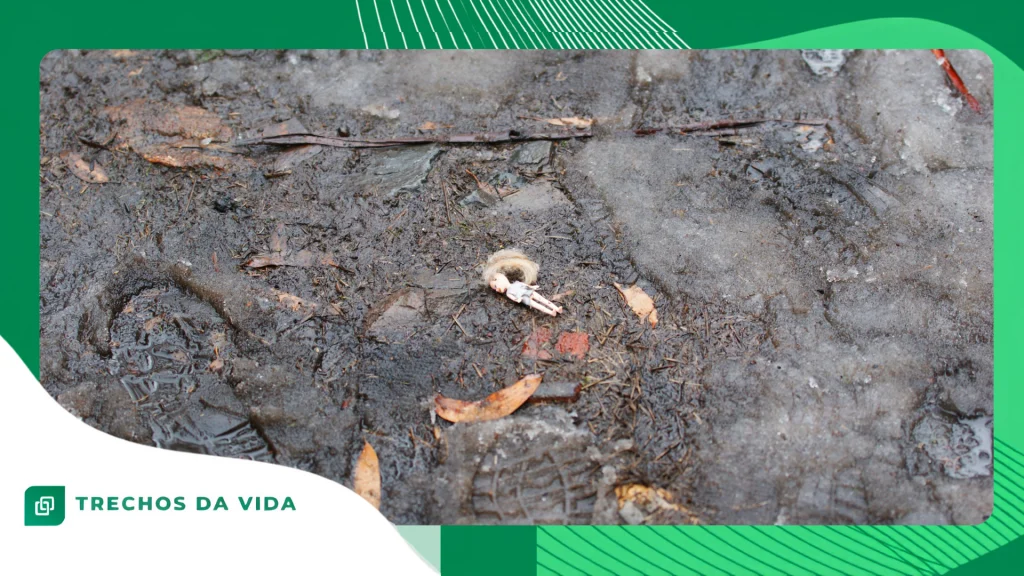
Scientists stumbled upon surprising human tracks in White Sands National Park, New Mexico.
This disturbing finding revealed a human presence in the Americas much earlier than the academic consensus had so vehemently defended.
The markings were protected within deep layers of fossilized plaster.
To determine the age of this maze of footprints, researchers analyzed seeds from local aquatic plants that were trapped in the footprints.
Another point that confounds our logic is in Laetoli, Tanzania.
There, hikers left marks in the damp volcanic ash that hardened like cement, immortalizing the bipedalism of hominids in an absurdly distant past.
Even in the unforgiving deserts of Saudi Arabia, recent fossil evidence has been found.
They prove that our ancestors crossed routes that, at the time, were green corridors full of lakes, and not the sand dunes of today.
The phenomenon of human footprints found in unlikely places It functions like a prehistoric GPS.
He redraws the paths our ancestors used as they explored the most hostile corners of the planet.
Every trace found in the middle of nowhere shatters a comfortable certainty of science.
Investigating these places requires the patience of a monk and surgical precision to avoid destroying what time took eons to protect.
How does science validate the authenticity of these traces?
Geologists use optically stimulated luminescence to date quartz grains.
This innovative technique can determine when the mineral last saw sunlight before being buried.
Radiocarbon dating comes into play to analyze organic remains attached around fossils.
This double filter weeds out conspiracy theories and grotesque hoaxes, separating fact from delusion.
The anatomy of the ancient foot is analyzed using three-dimensional laser scans.
Experts dissect the mechanics of the foot strike to calculate the weight, speed, and even the walking rhythm of that individual.
Stratigraphic studies map the integrity of the soil around the discovery.
This fine-toothed comb prevents marks caused by natural erosion or animals from being mistaken for human footprints by hasty eyes.
The hammer only falls after rigorous peer review and heated debates in reputable journals.
To understand how nature creates these temporal preservation traps, it's worth following the field reports of... National Geographic Brazil, which often translates this technical complexity with visual mastery.
++ Why do some mountains make strange sounds at night?
What are the main documented geological findings?
The table below organizes the most compelling data from these recent findings.
The overview clearly shows how these records change the rules of the game and force us to face our own expansion with more humility.
| Site Location | Estimated Age of Fossils | Soil Type and Preservation | Main Scientific Relevance |
| White Sands (USA) | 21,000 to 23,000 years | Gypsum and Lacustrine Sediment | It anticipates the settlement of the Americas. |
| Laetoli (Tanzania) | 3.6 million years | Solidified Volcanic Ash | Consolidates bipedalism in Africa |
| Saudi Arabia | 120,000 years | Ancient Lake Sediment | Maps migrations in green deserts. |
| Pilauco (Chile) | 15,600 years | Organic Peat Layer | Evidence of ancient occupation in the south. |
The data reveals that our ancestors were far more nomadic and resilient than we previously thought.
They occupied the globe, braving violent climatic whims without asking permission from deserts or ice ages.
++ Strange Messages from Space: What Science Has Investigated and Discarded
Why do these markers alter the chronology of humanity?

Historians have repeatedly stated that humans only set foot in the Americas at the end of the last great ice age.
The evidence of human footprints found in unlikely places They shattered that temporal barrier, pushing the dates back thousands of years.
The emergence of traces in extreme ecosystems starkly reveals our evolutionary stubbornness.
Our ancestors broke through brutal geographical boundaries long before they invented writing, the wheel, or any notion of planned agriculture.
Looking at these marks makes us question who really met whom along the way.
It is quite likely that different hominid lineages crossed paths and competed for the same valleys for generations.
Exhibitions around the globe are scrambling to update their collections and information panels.
Archaeology demonstrates its strength precisely by proving that historical truth is never static or immutable.
Field science now works hand in hand with modern genetic sequencing.
This connection between bones, footprints, and DNA reconstructs the human odyssey with a clarity that our grandparents never even dreamed of.
Deciphering these ancient paths forces us to respect the ground we walk on today. After all, the journey of civilization is an open book, full of blank pages ready to be rewritten.
To delve into the original articles that shook the foundations of anthropology, it is worthwhile to explore the scientific output of the prestigious... Nature, where major global findings are dissected.
++ The mystery of the world of rare black hole explosions.
Conclusion
These mysterious traces are an unsettling invitation to abandon our chronological arrogance.
Each footprint imprinted on the raw rock serves as a direct message from a past that refuses to be forgotten.
Protecting these archaeological sanctuaries should be a global priority, not a bureaucratic whim.
Ensuring the integrity of these soils means keeping the channel of communication open with our deepest origins.
The scientific race to unearth what is still hidden continues at a fast and exciting pace.
What we call an unsolvable mystery today may be, tomorrow, the new starting point of human history.
FAQ – Frequently Asked Questions
How do human footprints last so long in nature?
They need luck and perfect conditions: a footprint in damp mud or plaster that dries quickly and is buried by ash or sediment before the wind or water erases the record.
What is considered to be the oldest human footprint in the world?
The Laetoli footprints in Tanzania are approximately 3.6 million years old. They were left by hominids who walked upright on two legs and were eventually immortalized by thin volcanic lava.
Why is White Sands such an important archaeological site?
Because it proved that humans were hunting and living in North America during the height of the last ice age, overturning the theory that the continent was completely isolated and uninhabited.