Ice circles form naturally in frozen rivers.
You Ice circles They represent one of those rare moments when the physics of nature seems to flirt with the absurd, shaping the landscape in an almost unbelievable way.
Advertisements
These perfectly circular platforms emerge from the frozen riverbeds during periods of extreme cold, defying the perception of those who expect to find only chaos in a wild environment.
Below, you can follow how science unravels the geometry of this phenomenon and why its mechanics still provoke fascinated perplexity among researchers.
Summary
- How do ice circles form in rivers?
- What is the role of temperature and current?
- Where and when is it possible to observe this phenomenon?
- Comparative analysis of training conditions
- Frequently Asked Questions (FAQ)
How do ice circles form in rivers?
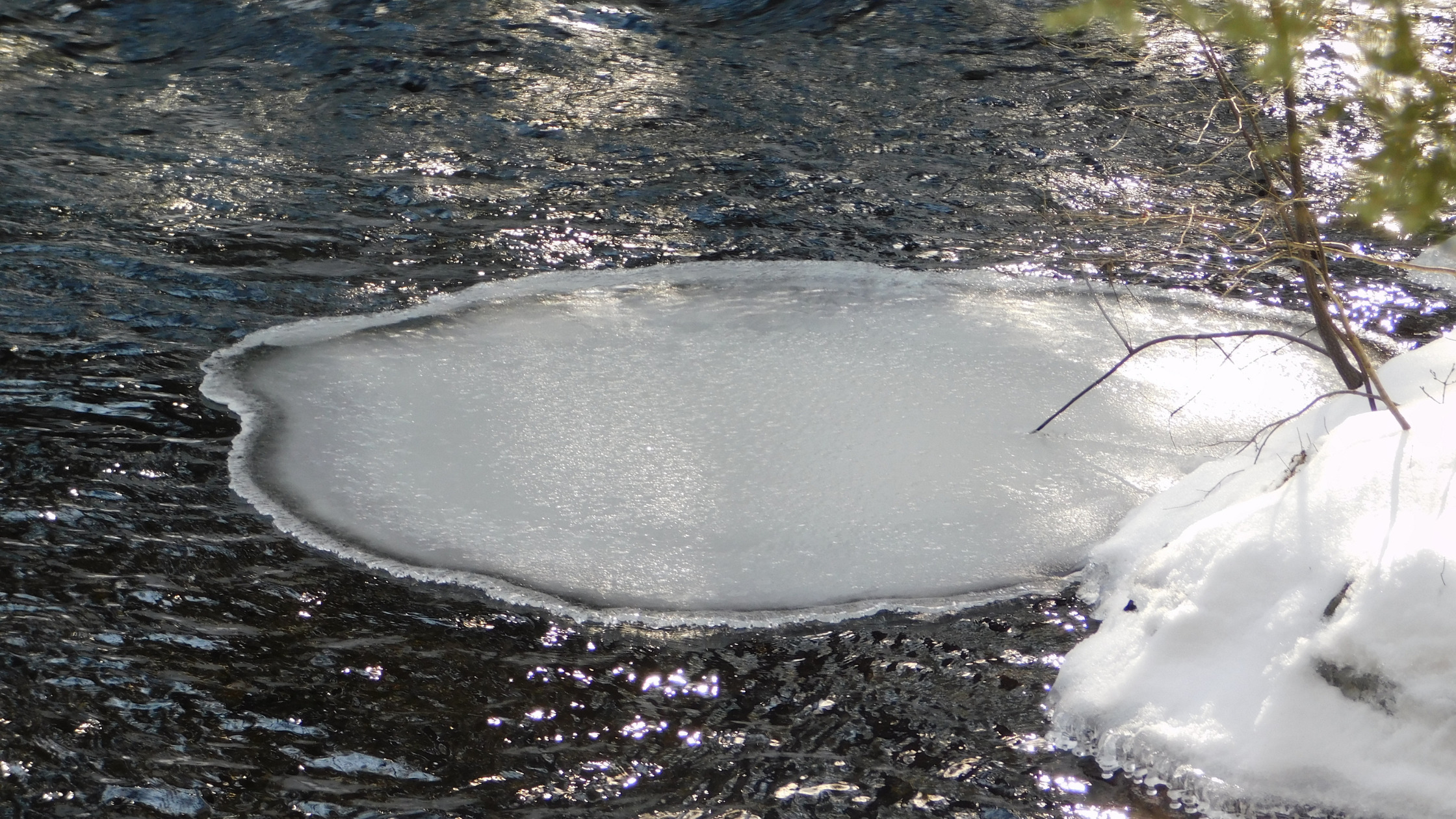
The formation of these oval or perfectly round platforms occurs when floating blocks become trapped in backwaters or sharp bends of calm-flowing rivers.
At these turning points, the continuous friction between the drift plate and the static ice of the bank wears away the sharp edges, sculpting a surprisingly smooth rim.
This continuous mechanical polishing process transforms irregular pieces into Ice circles perfectly symmetrical, kept in constant rotation by the vortex that generated them.
What is the role of temperature and current?
There is something curious about the internal dynamics of these discs: the variation in water density beneath the rigid crust acts as an invisible engine for rotation.
As the cooled water melts at the lower edge of the disc, it sinks because it becomes denser, inducing a vertical vortex that causes the whole thing to rotate on its own.
You can check the details of this hydraulic behavior in the study published in Natural Physical Sciences, which mapped the thermal forces and fluid motion.
Where and when is it possible to observe this phenomenon?
Records of these Ice circles They are concentrated during the peak of winters in the Northern Hemisphere, in countries such as the United States, Canada, Russia, and Sweden.
Slow-moving rivers in cold regions like Maine or the Scandinavian interior offer the perfect setting for discs to be preserved for days.
Witnessing the event requires a subtle combination of intense cold and a steady current — strong enough to rotate the structure, but gentle enough not to break it.
What methodologies do scientists use to monitor and record the mechanics of these rotations?
Detailed documentation of these formations requires a combination of modern technology and continuous observation in extremely cold conditions.
Research teams are using drones equipped with high-resolution cameras to capture aerial images that allow them to calculate the exact angular velocity of the disc over the course of hours.
Simultaneously, flow sensors and digital thermocouples are submerged around the rotating perimeter to measure the variation in water temperature at different depths.
These instruments provide essential data on the strength of the downward vortex, allowing the construction of dynamic computational models that accurately simulate the interaction between river hydraulics and frozen fluid mechanics.
++ Why do some trees live for thousands of years?
What is the impact of the river's size on the geometric perfection of the disc?
The size of the river channel directly influences the level of symmetry that the platform can achieve during the continuous process of mechanical sculpting.
In wider channels, the absence of lateral obstacles allows the centripetal force to act without abrupt interruptions, resulting in polished edges with almost mathematical precision.
In narrow streams, frequent contact with protruding rocks and submerged logs tends to interrupt rotation, generating oval shapes that are less durable.
++ Bioluminescent animals that light up oceans and forests.
Comparative analysis of training conditions
The following table systematizes the fundamental environmental variables for the phenomenon to establish itself stably in monitored river bodies.
| Environmental Parameter | Ideal Condition | Impact on the Structure |
| Air Temperature | Below -5 °C | Preserves the integrity of the disk. |
| Water Speed | Slow to moderate flow | Maintains rotation without breakage. |
| River Geometry | Meanders and curves | It provides the strength of the local vortex. |
Why does the continuous rotation of these discs impress the scientific community?
The image of a gigantic disc spinning in the center of a river without any visible mechanical propulsion often gives rise to unfounded hypotheses about human intervention.
The great fascination lies in how fluid physics solves the problem autonomously, creating a surprisingly efficient and stable self-maintaining system.
As friction reduces imperfections, the Ice circles They gain near-perfect momentum, reducing water resistance and allowing perpetual rotation to last for weeks.
How does the presence of these phenomena temporarily alter the local aquatic ecosystem?
The formation of a large rotating platform on the water's surface alters the dynamics of lighting and gas exchange in the stretch of the river directly affected by its physical structure.
The physical barrier created by the disc blocks direct sunlight from reaching the water column, temporarily reducing the photosynthetic activity of phytoplankton and submerged vegetation under the continuous shaded area.
Furthermore, the constant movement of the vertical vortex created at the lower edge drives the circulation of nutrients retained at the bottom of the bed, locally increasing water oxygenation at freezing temperatures.
This dynamic microenvironment attracts small species of fish and invertebrate organisms seeking shelter from the main current, transforming the space under the platform into a temporary thermal refuge in the middle of winter.
What climatic factors could threaten the preservation of these icy structures?

The subtle thermal balance required for the formation and maintenance of these disks makes them extremely vulnerable to abrupt temperature fluctuations caused by microclimatic events.
When a slightly warmer air mass reaches the river channel or unseasonal rainfall occurs, the integrity of the riverbed is quickly compromised.
Rainwater weakens the center of the rotating block, while small variations in river flow destabilize the supporting vortex, causing the piece to collide with the bank and fragment in a few minutes.
++ Red tides: the phenomenon that changes the color of the oceans.
Conclusion
Observe the Ice circles It is about embracing the capacity of water to create aesthetic order from the most basic thermal movement.
This precise interplay between fluid dynamics and meteorological rigor transforms everyday rivers into spaces of ephemeral sculptures that last only as long as the cold allows.
To access scientific data on the impact of climate change on these aquatic ecosystems, consult the archive of... US Geological Survey, a global reference in environmental research.
Frequently Asked Questions (FAQ)
Are ice circles caused by human intervention?
No, the formation is entirely natural and results from the constant friction between the ice and the eddies formed by the river's current itself.
How long can a record like this last?
The duration varies from a few hours to entire weeks, depending on the persistence of the severe cold and the stability of the water flow under the plate.
What is the maximum size these structures can reach?
There are documented records of small formations ranging from a few meters in size to gigantic discs over 100 meters in diameter rotating slowly.